
Phobos
Mars has two tiny moons, named Phobos, meaning fear, and Deimos, meaning panic. There are several topics of interest related to Phobos.
In Gulliver's Travels Jonathan Swift talked about Phobos & Deimos 150 years before their actual discovery.
Phobos' orbit is speeding up, leading scientists to believe that it is lighter than its size dictates, it might be hollow.
The Russian Phobos 1 mission failed.
The Russian Phobos 2 mission failed too, an "object that should not have been there" appears on the last photo.
The Jonathan Swift issue about Phobos; an Immodest Proposal
In 1726 Jonathan Swift publishes Gulliver's Travels, which describes the imaginary exploits of Lemuel Gulliver. He learns that the scientists from the Laputa island have...
"...discovered two lesser stars, or satellites, which revolve about Mars; whereof the innermost is distant from the center of the primary planet exactly three of its diameters, and the outermost five; the former revolves in the space of ten hours, and the latter in twenty one and a half; so that the squares of their periodical times are very near in the same proportion with the cubes of their distance from the center of Mars; which evidently shows them to be governed by the same law of gravitation that influences the other heavenly bodies."

Swift's prediction is quite surprising, given the fact that there were no powerful enough telescopes on earth then to spot the moons at this time: The number of moons is correct. He places them close to the planet, and they are. The distances relation between the moons and Mars is quite correct. The moons could not be actually seen before 1877, 151 years later. The 1750 story Micromégas, by Voltaire, which deals with an inhabitant of Sirius visiting our solar system, also mentions the two Martians moons; he obviously read Gulliver's Travels.
In Greek mythology, Deimos was the personification of dread, and also the son of Ares and Aphrodite (or Mars and Venus, to the Romans). He, his twin brother Phobos and the goddess Enyo accompanied Ares into battle, as well as his father's attendants, Trembling, Fear, Dread, and Panic. His Roman equivalent was Formido or Metus. (Wikipedia)
Of course one wonders why a UFO should have an antenna, and why an antenna -a thing supposed to be rather small- should be seen on an infrared photo blurred enough not to reveal the Phobos craters properly. One can also suppose that a smeared image of a moving debris would result in a regular trail, not a trail with a narrow beginning, a long enlargement and a slightly widened head. Unless maybe the debris changed speed inside the 8 seconds exposure, which would raise more questions. Then, If it is not a trail, the elongated shape would be a sufficient indicator of artificiality-- or at least strangeness.
 Actually there is a second strange Phobos 2 photo, an elongated shadow on the Martian surface, that was considered as an UFO shadow by some. It is certainly a source of great confusions when rational explanations are provided on this photo while the other is ignored and vice-versa. Here is an interesting text about the last photos from Phobos 2, by an unknown author:
An unusual photo of a thin shadow across Mars was shown on the Russian television segment. Seen on the surface of Mars was a clearly defined dark shape that could indeed be described, as it was in he initial dispatch from Moscow, as a "thin ellipse" (this photo is a still from the Soviet television clip). It was certainly different from the shadow of Phobos recorded eighteen years earlier by Mariner 9. The latter cast a shadow that was a rounded ellipse and fuzzy at the edges, as would be cast by the uneven surface of the moonlet. The 'anomaly' seen in the Phobos 2 transmission was a thin ellipse with very sharp rather than rounded points (the shape is known in the diamond trade as a "marquise") and the edges, rather than being fuzzy, stood out sharply against a kind of halo on the Martian surface. Dr. Becklake described it as "something that is between the spacecraft and Mars, because we can see the Martian surface below it," and stressed that the object was seen by both the optical and the infrared (heat seeking) camera.
 All these reasons explain why the Soviets have not suggested that the dark, "thin ellipse" might have been a shadow of the moonlet. While the image was held on the screen, Dr. Becklake explained that it was taken as the spacecraft was aligning itself with Phobos (the moonlet). "As the last picture was halfway through," he said, "they [Soviets] saw something that should not be there." The Soviets, he went on to state, have not yet released this last picture, and we wont speculate on what it shows. So what was it that collided or crashed into Phobos 2? Was the space probe shot out of space for "seeing too much"? What does the last secret frame show? In his careful words to 'Aviation Week and Space Technology', the chairman of the Soviet equivalent of NASA, referred to the last frame, saying, "One image appears to include an odd-shaped object between the spacecraft and Mars."
This "highly secret" photo was later given to the Western press by Colonel Dr. Marina Popovich, a Russian astronaut and pilot who has long been interested in UFO's. At a UFO conference in 1991, Popovich gave to certain investigators some interesting information that she "smuggled" out of the now ex-Soviet Union. Part of the information was what has been called "the first ever leaked accounts of an alien mother ship in the solar system". The last transmission from Phobos 2 was a photograph of a gigantic cylindrical spaceship - a huge, approx, 20km long, 1.5km diameter cigar-shaped 'mother ship', that was photographed on 25 March 1989 hanging or parked next to the Martian moon Phobos by the Soviet unmanned probe Phobos 2. After that last frame was radio-transmitted back to Earth, the probe mysteriously disappeared; according to the Russians it was destroyed - possibly knocked out with an energy pulse beam.
 The cigar shaped craft in the penultimate frame taken by Phobos 2 is apparently the object casting the oblong shadow on the surface of Mars in the earlier photo. Australian science writer Brian Crowley says that because of the convex cats eye shadow - which, because the overhead solar inclination prevented shadow- casting by Martian surface features, implies a shadow thrown on the surface from something in orbit - beyond the orbit of Phobos 2 itself. The shadow - spindle - or cigar shaped - is inconsistent with any possible shadow cast by the moon Phobos, which is an irregular potato shape. One needs little imagination to postulate a giant, hovering cigar- shaped mother craft similar to those documented down the years by UFO investigators.
 On March 31, 1989 Headlines dispatched by the Moscow correspondents of the European News Agency (EFE) stated: "Phobos 2 Captured Strange Photos of Mars Before Losing Contact With Its Base." Vremya revealed yesterday that the space probe Phobos II, which was orbiting above Mars when Soviet scientists lost contact with it on Monday, had photographed an UNIDENTIFIED OBJECT on the Martian surface seconds before losing contact." Scientists described the UNIDENTIFIED OBJECT as a thin ellipse 20 KILOMETERS LONG! It was further stated that the photos could not be an illusion because it was captured by 2 different color cameras as well as cameras taking infrared shots. One controller at the Kaliningrad control center concluded that the probe was now spinning out of control. It would seem that something struck or shot the Phobos II Probe.
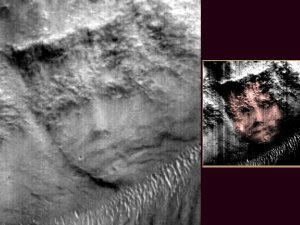
In the October 19, 1989 issue of Nature Magazine, Soviet scientists concluded that the craft could be spinning because it was impacted. It has long been rumored that Mars and its moon Phobos are alien colonies. The surface of Mars is covered with strange shapes/buildings that do not appear to be natural such as the pyramids, square buildings, runways, etc. One structure shows the face of a man with a helmet looking into space. It can be seen at the National Space Science Data Center, Viking photo with catalog number 76-A-593/17384 Titled "HEAD." Another photo is 070-A-13. There are now eleven Viking photographs (and growing) of this obviously intelligently constructed monument on the surface of Mars. The "HEAD" and other artificial features such as the pyramids were combined by electrical engineer and imaging specialist Vincent DiPietro and a Lockheed computer scientist. The composite images seemed to show that the features on the surface of Mars had been artificially sculpted.

An interesting although unverified text about the loss of Phobos 2, author unknown:
PHOBOS: MALFUNCTION OR EARLY STAR WARS INCIDENT?
Phobos, one of the two moons of Mars, has itself always been considered a rather mysterious object, as has its smaller twin, Deimos. Joseph Shklovskii noted member of the Soviet Academy of science and co-writer with Dr Carl Sagan of 'Intelligent life in the universe', once calculated from the estimated density of the Martian atmosphere and the peculiar "acceleration" of Phobos, that the satellite must be hollow. Could Phobos be a hollowed-out space station of huge proportions? In July 1988, the Russians launched two unmanned satellite probes - Phobos 1 and Phobos 2 - in the direction of Mars, and with the primary intention of investigating the planet's mysterious moon, Phobos. Phobos 1 was unfortunately lost en route two months later, reportedly because of a radio command error.

The television clip was shown by some TV stations in Europe and Canada as part of weekly 'diary' programs, as a curiosity and not as a hot news item. The television sequence thus released focused on two anomalies. The first was a network of straight lines in the area of the Martian equator; some of the lines were short, some were longer, some were thin, some were wide enough to look like rectangular shapes 'embossed' in the Martian surface. Arranged in rows parallel to each other, the pattern covered an area of some six hundred square kilometers (more than two hundred and thirty square miles). The anomaly appeared to be far from a natural phenomenon. The television clip was accompanied by a live comment by Dr. John Becklake of the London Science Museum.
He described the phenomenon as very puzzling, because the pattern seen on the surface of Mars was photographed not with the spacecraft's optical camera but with its infrared camera- a camera that takes pictures of objects using the heat that they radiate, and not by the play of light and shadow on them. In other words, the pattern of parallel lines and rectangles covering an area of almost two hundred and fifty square miles was a source of heat radiation. It is so highly unlikely that a natural source of heat radiation (a geyser or a concentration of radioactive minerals under the surface, for example) would create such a perfect geometric pattern. When viewed over and over again, the pattern definitely looks artificial; but as for what it was, the scientist said "I certainly don't know." According to Boris Bolitsky, science correspondent for Radio Moscow, just before radio contact was lost with Phobos 2, several unusual images were radioed back to Earth, described by the Russian as "Quite remarkable features". A report taken from New Scientist of 8 April 1989, described the following:
"The features are either on the Martian surface or in the lower atmosphere. The features are between 20 and 25 kilometers wide and do not resemble any known geological formation. They are spindle - shaped and proving to be intriguing and puzzling." Since no coordinates for the precise location of this "anomalous feature" have been released publicly, it is impossible to judge its relationship to another puzzling feature on the surface of Mars that can be seen in Mariner 9 frame 4209-75. It is also located in the equatorial area (at longitude 186.4) and has been described as "unusual indentations with radial arms protruding from a central hub," caused (according to NASA scientists) by the melting and collapse of permafrost layers. The design of the features, bringing to mind the structure of a modern airport with a circular hub from which long structures housing the airplane gates radiate, can be better visualized when the photograph is reversed (showing depressions and protrusions).
In 1726 Jonathan Swift publishes Gulliver's Travels, which describes the imaginary exploits of Lemuel Gulliver. He learns that the scientists from the Laputa island have...
"...discovered two lesser stars, or satellites, which revolve about Mars; whereof the innermost is distant from the center of the primary planet exactly three of its diameters, and the outermost five; the former revolves in the space of ten hours, and the latter in twenty one and a half; so that the squares of their periodical times are very near in the same proportion with the cubes of their distance from the center of Mars; which evidently shows them to be governed by the same law of gravitation that influences the other heavenly bodies."
Swift's prediction is quite surprising, given the fact that there were no powerful enough telescopes on earth then to spot the moons at this time: The number of moons is correct. He places them close to the planet, and they are. The distances relation between the moons and Mars is quite correct. The moons could not be actually seen before 1877, 151 years later. The 1750 story Micromégas, by Voltaire, which deals with an inhabitant of Sirius visiting our solar system, also mentions the two Martians moons; he obviously read Gulliver's Travels.
The Swift story is a starting point for theories in which Phobos would be an 'advanced logistic base' used by aliens on their visit to our planet.
But there is also a less disturbing explanation: Swift knew of the 'celestial harmony' concepts proposed by Kepler. The idea was that the planets of the solar system must have an increasing number of satellites progressing as their distance with the sun is.
At the time it was believed that:
- Mercury has 0 satellites,
- Venus has 0 satellite,
- The Earth has 1,
- Mars has ?,
- Jupiter has 4,
- Saturn has 5.
Since they could not be seen, maybe he guessed that they had to be very small, and also close to the planet so that they would be lost in its glare. So much for the Jonathan Swift discovery! Unless you wish to check if there is more to it...
In Greek mythology, Deimos was the personification of dread, and also the son of Ares and Aphrodite (or Mars and Venus, to the Romans). He, his twin brother Phobos and the goddess Enyo accompanied Ares into battle, as well as his father's attendants, Trembling, Fear, Dread, and Panic. His Roman equivalent was Formido or Metus. (Wikipedia)
DID PHOBOS PROBE MEET WITH A UFO?
 The Soviet Phobos 2 probe was sent to examine the Martian moon Phobos (The USSR was interested in the possibility of using Phobos as a staging post for a manned exploration of Mars) Maybe one of the mission's goal was to find more about the strange chain craters on Phobos? (January 1977 issue of 'Astronomy' author anonymous). On March 28, 1989, Russian ground controllers suddenly and unexpectedly lost contact with their Phobos 2 probe. The very last close-up infrared photo of Phobos snapped by the spacecraft shows 'an object which shouldn't have been there'.
 The Soviet Phobos 2 probe was sent to examine the Martian moon Phobos (The USSR was interested in the possibility of using Phobos as a staging post for a manned exploration of Mars) Maybe one of the mission's goal was to find more about the strange chain craters on Phobos? (January 1977 issue of 'Astronomy' author anonymous). On March 28, 1989, Russian ground controllers suddenly and unexpectedly lost contact with their Phobos 2 probe. The very last close-up infrared photo of Phobos snapped by the spacecraft shows 'an object which shouldn't have been there'.
The Phobos Mystery Object (PMO) as it was referred to was soon believed to be a UFO by some. It was also speculated that the Russian mission had been deliberately terminated by aliens unwilling to let Phobos 2 approach the moon, supposed to be an artificial avant-poste of alien visitors on their way to earth. This scenario fit with the other mysteries: the supposed hollow nature of the moon suggested by its strange gravitational behaviour, its strange closeness to the Martian surface, its visionary discovery by Jonathan Swift, the failure of Hershell and others to discover it and the sudden discovery by Hall that suggested it was not there before, the failure of Phobos 1, and all the other more famous Martian mysteries.
The final infrared picture photo of Phobos occurred just three days before the communication failure, it reveals the outlines of both Phobos and the PMO. All surface detail is washed out on both objects which is very common in infrared pictures. If the PMO was at the same distance as Phobos itself, it would be about 2 kilometers wide and 20 long. Its surface brightness is the same as that of Phobos. The sides of the PMO are perfectly parallel; it is rounded at both ends; the end towards Phobos narrows slightly; the other end seems to have a slight protrusion. An attempt to explain the presence of the object was that...
"...since the PMO does not appear to have a metallic surface and displays no antennas or other indicators of artificiality, it is reasonable to ask whether it might be some natural phenomenon. One possibility is that the PMO image is only a "trailed moonlet;" that is, the smeared image of a small piece of debris also in orbit about Mars but moving at a slightly different velocity from that of the spacecraft and Phobos. Since the exposure time of the last photo was 8 seconds, a smeared image due to the PMO's relative motion is reasonable." (Anonymous; "Mystery Object Encountered by Russian Phobos Spacecraft," Meta Research Bulletin, 1:1, March 15, 1992.)
The final infrared picture photo of Phobos occurred just three days before the communication failure, it reveals the outlines of both Phobos and the PMO. All surface detail is washed out on both objects which is very common in infrared pictures. If the PMO was at the same distance as Phobos itself, it would be about 2 kilometers wide and 20 long. Its surface brightness is the same as that of Phobos. The sides of the PMO are perfectly parallel; it is rounded at both ends; the end towards Phobos narrows slightly; the other end seems to have a slight protrusion. An attempt to explain the presence of the object was that...
"...since the PMO does not appear to have a metallic surface and displays no antennas or other indicators of artificiality, it is reasonable to ask whether it might be some natural phenomenon. One possibility is that the PMO image is only a "trailed moonlet;" that is, the smeared image of a small piece of debris also in orbit about Mars but moving at a slightly different velocity from that of the spacecraft and Phobos. Since the exposure time of the last photo was 8 seconds, a smeared image due to the PMO's relative motion is reasonable." (Anonymous; "Mystery Object Encountered by Russian Phobos Spacecraft," Meta Research Bulletin, 1:1, March 15, 1992.)
Of course one wonders why a UFO should have an antenna, and why an antenna -a thing supposed to be rather small- should be seen on an infrared photo blurred enough not to reveal the Phobos craters properly. One can also suppose that a smeared image of a moving debris would result in a regular trail, not a trail with a narrow beginning, a long enlargement and a slightly widened head. Unless maybe the debris changed speed inside the 8 seconds exposure, which would raise more questions. Then, If it is not a trail, the elongated shape would be a sufficient indicator of artificiality-- or at least strangeness.
 Actually there is a second strange Phobos 2 photo, an elongated shadow on the Martian surface, that was considered as an UFO shadow by some. It is certainly a source of great confusions when rational explanations are provided on this photo while the other is ignored and vice-versa. Here is an interesting text about the last photos from Phobos 2, by an unknown author:
An unusual photo of a thin shadow across Mars was shown on the Russian television segment. Seen on the surface of Mars was a clearly defined dark shape that could indeed be described, as it was in he initial dispatch from Moscow, as a "thin ellipse" (this photo is a still from the Soviet television clip). It was certainly different from the shadow of Phobos recorded eighteen years earlier by Mariner 9. The latter cast a shadow that was a rounded ellipse and fuzzy at the edges, as would be cast by the uneven surface of the moonlet. The 'anomaly' seen in the Phobos 2 transmission was a thin ellipse with very sharp rather than rounded points (the shape is known in the diamond trade as a "marquise") and the edges, rather than being fuzzy, stood out sharply against a kind of halo on the Martian surface. Dr. Becklake described it as "something that is between the spacecraft and Mars, because we can see the Martian surface below it," and stressed that the object was seen by both the optical and the infrared (heat seeking) camera.
 All these reasons explain why the Soviets have not suggested that the dark, "thin ellipse" might have been a shadow of the moonlet. While the image was held on the screen, Dr. Becklake explained that it was taken as the spacecraft was aligning itself with Phobos (the moonlet). "As the last picture was halfway through," he said, "they [Soviets] saw something that should not be there." The Soviets, he went on to state, have not yet released this last picture, and we wont speculate on what it shows. So what was it that collided or crashed into Phobos 2? Was the space probe shot out of space for "seeing too much"? What does the last secret frame show? In his careful words to 'Aviation Week and Space Technology', the chairman of the Soviet equivalent of NASA, referred to the last frame, saying, "One image appears to include an odd-shaped object between the spacecraft and Mars."
This "highly secret" photo was later given to the Western press by Colonel Dr. Marina Popovich, a Russian astronaut and pilot who has long been interested in UFO's. At a UFO conference in 1991, Popovich gave to certain investigators some interesting information that she "smuggled" out of the now ex-Soviet Union. Part of the information was what has been called "the first ever leaked accounts of an alien mother ship in the solar system". The last transmission from Phobos 2 was a photograph of a gigantic cylindrical spaceship - a huge, approx, 20km long, 1.5km diameter cigar-shaped 'mother ship', that was photographed on 25 March 1989 hanging or parked next to the Martian moon Phobos by the Soviet unmanned probe Phobos 2. After that last frame was radio-transmitted back to Earth, the probe mysteriously disappeared; according to the Russians it was destroyed - possibly knocked out with an energy pulse beam.
 The cigar shaped craft in the penultimate frame taken by Phobos 2 is apparently the object casting the oblong shadow on the surface of Mars in the earlier photo. Australian science writer Brian Crowley says that because of the convex cats eye shadow - which, because the overhead solar inclination prevented shadow- casting by Martian surface features, implies a shadow thrown on the surface from something in orbit - beyond the orbit of Phobos 2 itself. The shadow - spindle - or cigar shaped - is inconsistent with any possible shadow cast by the moon Phobos, which is an irregular potato shape. One needs little imagination to postulate a giant, hovering cigar- shaped mother craft similar to those documented down the years by UFO investigators.
 On March 31, 1989 Headlines dispatched by the Moscow correspondents of the European News Agency (EFE) stated: "Phobos 2 Captured Strange Photos of Mars Before Losing Contact With Its Base." Vremya revealed yesterday that the space probe Phobos II, which was orbiting above Mars when Soviet scientists lost contact with it on Monday, had photographed an UNIDENTIFIED OBJECT on the Martian surface seconds before losing contact." Scientists described the UNIDENTIFIED OBJECT as a thin ellipse 20 KILOMETERS LONG! It was further stated that the photos could not be an illusion because it was captured by 2 different color cameras as well as cameras taking infrared shots. One controller at the Kaliningrad control center concluded that the probe was now spinning out of control. It would seem that something struck or shot the Phobos II Probe.
In the October 19, 1989 issue of Nature Magazine, Soviet scientists concluded that the craft could be spinning because it was impacted. It has long been rumored that Mars and its moon Phobos are alien colonies. The surface of Mars is covered with strange shapes/buildings that do not appear to be natural such as the pyramids, square buildings, runways, etc. One structure shows the face of a man with a helmet looking into space. It can be seen at the National Space Science Data Center, Viking photo with catalog number 76-A-593/17384 Titled "HEAD." Another photo is 070-A-13. There are now eleven Viking photographs (and growing) of this obviously intelligently constructed monument on the surface of Mars. The "HEAD" and other artificial features such as the pyramids were combined by electrical engineer and imaging specialist Vincent DiPietro and a Lockheed computer scientist. The composite images seemed to show that the features on the surface of Mars had been artificially sculpted.

An interesting although unverified text about the loss of Phobos 2, author unknown:
PHOBOS: MALFUNCTION OR EARLY STAR WARS INCIDENT?
Phobos, one of the two moons of Mars, has itself always been considered a rather mysterious object, as has its smaller twin, Deimos. Joseph Shklovskii noted member of the Soviet Academy of science and co-writer with Dr Carl Sagan of 'Intelligent life in the universe', once calculated from the estimated density of the Martian atmosphere and the peculiar "acceleration" of Phobos, that the satellite must be hollow. Could Phobos be a hollowed-out space station of huge proportions? In July 1988, the Russians launched two unmanned satellite probes - Phobos 1 and Phobos 2 - in the direction of Mars, and with the primary intention of investigating the planet's mysterious moon, Phobos. Phobos 1 was unfortunately lost en route two months later, reportedly because of a radio command error.
Phobos 2 was also ultimately lost in the most intriguing circumstances, but not before it had beamed back certain images and information from the planet Mars itself. Phobos 2 arrived safely at Mars in January 1989 and entered into an orbit around Mars as the first step at its destination towards its ultimate goal: to transfer to an orbit that the would make it fly almost in tandem with the Martian moonlet called Phobos (hence the spacecraft name) and explore the moonlet with highly sophisticated equipment that included two packages of instruments to be placed on the moonlet's surface. All went well until Phobos 2 aligned itself with Phobos, the Martian moonlet. Then, on 28th March, the Soviet mission control center acknowledged sudden communication "problems" with the spacecraft; and Tass, the official Soviet news agency, reported that "Phobos 2 had failed to communicate with Earth as scheduled after completing an operation yesterday around the Martian moon Phobos. Scientists at mission control have been unable to establish stable radio contact." What had caused the Phobos 2 spacecraft to be lost? The answer came about three months later. Pressed by the international participants in the Phobos mission to provide definitive data, the Soviet authorities released a taped television transmission Phobos 2 sent in its last moments except for the last frames, taken just seconds before the spacecraft fell silent.
The television clip was shown by some TV stations in Europe and Canada as part of weekly 'diary' programs, as a curiosity and not as a hot news item. The television sequence thus released focused on two anomalies. The first was a network of straight lines in the area of the Martian equator; some of the lines were short, some were longer, some were thin, some were wide enough to look like rectangular shapes 'embossed' in the Martian surface. Arranged in rows parallel to each other, the pattern covered an area of some six hundred square kilometers (more than two hundred and thirty square miles). The anomaly appeared to be far from a natural phenomenon. The television clip was accompanied by a live comment by Dr. John Becklake of the London Science Museum.
He described the phenomenon as very puzzling, because the pattern seen on the surface of Mars was photographed not with the spacecraft's optical camera but with its infrared camera- a camera that takes pictures of objects using the heat that they radiate, and not by the play of light and shadow on them. In other words, the pattern of parallel lines and rectangles covering an area of almost two hundred and fifty square miles was a source of heat radiation. It is so highly unlikely that a natural source of heat radiation (a geyser or a concentration of radioactive minerals under the surface, for example) would create such a perfect geometric pattern. When viewed over and over again, the pattern definitely looks artificial; but as for what it was, the scientist said "I certainly don't know." According to Boris Bolitsky, science correspondent for Radio Moscow, just before radio contact was lost with Phobos 2, several unusual images were radioed back to Earth, described by the Russian as "Quite remarkable features". A report taken from New Scientist of 8 April 1989, described the following:
"The features are either on the Martian surface or in the lower atmosphere. The features are between 20 and 25 kilometers wide and do not resemble any known geological formation. They are spindle - shaped and proving to be intriguing and puzzling." Since no coordinates for the precise location of this "anomalous feature" have been released publicly, it is impossible to judge its relationship to another puzzling feature on the surface of Mars that can be seen in Mariner 9 frame 4209-75. It is also located in the equatorial area (at longitude 186.4) and has been described as "unusual indentations with radial arms protruding from a central hub," caused (according to NASA scientists) by the melting and collapse of permafrost layers. The design of the features, bringing to mind the structure of a modern airport with a circular hub from which long structures housing the airplane gates radiate, can be better visualized when the photograph is reversed (showing depressions and protrusions).




 (Click on pictures to enlarge images and text.)


 Posts
Posts


