Showing posts with label mothman. Show all posts

Sunday, August 30, 2009

MOTHMAN Part 2

Fair Use Notice: This page may contain copyrighted material the use of which has not been specifically authorized by the copyright owner. This website distributes this material without profit to those who have expressed a prior interest in receiving the included information for research and educational purposes. We believe this constitutes a fair use of any such copyrighted material as provided for in 17 U.S.C. § 107.
MOTHMAN
PART 2


http://www.feebleminds-gifs.com/moth-man.gif

John Alva Keel (born Alva John Kiehle on March 25, 1930 and died July 3, 2009) was a Fortean author and professional journalist.

FROM WIKIPEDIA

Keel wrote professionally from the age of 12, and was best known for his writings on unidentified flying objects, the "Mothman" of West Virginia, and other paranormal subjects. Keel was arguably one of the most widely read and influential ufologists since the early 1970s.[2] Although his own thoughts about UFOs and associated anomalous phenomena gradually evolved since the mid 1960s, Keel remained one of ufology's most original and controversial researchers. It was Keel's second book, UFOs: Operation Trojan Horse (1970), that popularized the idea that many aspects of contemporary UFO reports, including humanoid encounters, often paralleled ancient folklore and religious encounters. Keel coined the term "men in black" to describe the mysterious figures alleged to harass UFO witnesses[3]and he also argued that there is a direct relationship between UFOs and psychic phenomena. He did not call himself a ufologist and preferred the term Fortean, which encompasses a wide range of paranormal subjects.

Keel's first published story was in a magician's magazine at the age of 12. He later moved to Greenwich Village and wrote for various magazines. He was drafted into the United States Army during the Korean War, but served in Frankfurt, Germany on the staff of the Armed Forces Network. He was then employed as a press correspondent for several years, before resigning to tour Egypt and the Middle East. His first published book, Jadoo (1957), was serialised in a men's adventure magazine. Jadoo details Keel's travels to India to investigate the alleged activities of fakirs and holy men who perform the Indian rope trick and who survive being buried alive.

Influenced by writers such as Charles Fort, Ivan Sanderson, and Aimé Michel, in early 1966, John Keel commenced a full-time investigation of UFOs and paranormal phenomena. Over a four-year period, Keel interviewed thousands of people in over twenty U.S. states. He read over 2,000 books in the course of this investigation, in addition to thousands of magazines, newsletters, and newspapers. Keel also subscribed to several newspaper-clipping services, which often generated up to 150 clippings for a single day during the 1966 and 1967 UFO "wave". Keel wrote for several magazines including Saga with one 1967 article UFO Agents of Terror referring to the Men in Black.


Like contemporary 1960s researchers such as J. Allen Hynek and Jacques Vallée, Keel was initially hopeful that he could somehow validate the prevailing extraterrestrial visitation hypothesis. However, after one year of investigations, Keel concluded that the extraterrestrial hypothesis was untenable. Indeed, both Hynek and Vallée eventually arrived at a similar conclusion. As Keel himself wrote:

I abandoned the extraterrestrial hypothesis in 1967 when my own field investigations disclosed an astonishing overlap between psychic phenomena and UFOs... The objects and apparitions do not necessarily originate on another planet and may not even exist as permanent constructions of matter. It is more likely that we see what we want to see and interpret such visions according to our contemporary beliefs.[6]

In UFOs: Operation Trojan Horse Keel argues that a non-human or spiritual intelligence source has staged whole events over a long period of time in order to propagate and reinforce certain erroneous belief systems. For example, the fairy faith in Middle Europe, vampire legends, mystery airships in 1897, mystery aeroplanes of the 1930s, mystery helicopters, anomalous creature sightings, poltergeist phenomena, balls of light, and UFOs. Keel conjectured that ultimately all of these anomalies are a cover for the real phenomenon. In Our Haunted Planet,

Keel coined the term "Ultraterrestrials" to describe the UFO occupants. He discussed the seldom-considered possibility that the alien "visitors" to Earth are not visitors at all, but an advanced Earth civilization, which may or may not be human.

Keel took no position on the ultimate purpose of the phenomenon other than that the UFO intelligence seems to have a long-standing interest in interacting with the human race.

In 1975, Keel published The Mothman Prophecies, an account of his 1966-1967 investigation of sightings of the Mothman, a strange winged creature reported in and around Point Pleasant, West Virginia. The book was loosely adapted into a 2002 movie, starring Richard Gere, Laura Linney and Alan Bates. Those two actors played two parts of Keel's personality. Bates's character was "Leek," which was "Keel" spelled backwards, and Gere's character worked for a newspaper, "John Klein," also a play on Keel's name.

In the May/June 2002 issue of Skeptical Inquirer, journalist John C. Sherwood, a former business associate of UFO researcher Gray Barker, published an analysis of private letters between Keel and Barker during the period of Keel's investigation. In the article, "Gray Barker's Book of Bunk," Sherwood reported finding significant differences between what Keel wrote at the time of his investigation and what he wrote in his first book about the Mothman reports, raising questions about the book's accuracy. Sherwood also reported that Keel, who was well known for writing humorous and outrageous letters to friends and associates, would not assist him in clarifying the differences thus raising doubts about Sherwood's supposition.

On Friday October 13, 2006, Keel admitted himself to New York City's Lenox Hill Hospital, having suffered a heart attack, and underwent successful heart surgery on October 16. Keel then was moved from the hospital to a rehabilitation center on October 26, according to his friend Doug Skinner who remained in contact with him and who requested that well wishers contact Keel by mail in order to give him time to recover. Although annoyed by postings of his premature death, Keel continued to improve for some time. In early 2009, Keel moved into a nursing home near his apartment on the Upper West Side.

He died on July 3, 2009, at Mount Sinai Hospital in New York City, at the age of 79.


Mothman stories in Point Pleasant, 1966: facts and fiction
UFO PHENOMENON AT CLOSE SIGHT
http://www.ufologie.net/indexe.htm

During a discussion, a participant argued that John Keel provided

evidence that show that those beings believed to be extraterrestrial are not extraterrestrial but some illusion created by some yet to be determined non-extraterrestrial intelligence or phenomena.

Let me quote John Keel, who introduces his main point better himself:

"I abandoned the extraterrestrial hypothesis in 1967 when my own field investigations disclosed an astonishing overlap between psychic phenomena and UFOs [...] I feel that the ultimate solution [to the UFO question] will involve a complicated system of new physics related to theories of the space-time continuum [...] The objects and apparitions do not necessarily originate on another planet and may not even exist as permanent constructions of matter. It is more likely that we see what we want to see and interpret such visions according to our contemporary beliefs."

One commenter elaborated:

"Keel is a disbeliever in the extraterrestrial theory of UFO origin. He subscribes to the theory that Earth is not so much a sovereign world controlled by human beings as it is some type of property belonging to entities from a plane of existence separate from ours. According to Keel, these entities are no more divine than we are, but are as much a part of Earth as mankind is, and have always been with us."
"Drawing on his background in folklore and the occult, Keel has dubbed these higher entities "Ultraterrestrials" (UTs). He believes UTs are the gods of our ancestors. Their influence is responsible for all human progress and human woe, from religious and scientific enlightenment to wars and murderous cults. Because our modern culture thinks in terms of spaceships and visitors from other planets, that is how we see the Ultraterrestrials when they manifest themselves today."

I answered that I did not feel necessary to grant particular credence to the stories of John Keel, which are not of the nature of a research of facts nor a scientific research; that the theory that John Keel proposes has, among other weaknesses, that of not resting strictly on factual bases.

The person then asked me the following question:

"Do you have elements or particular information showing that John A. Keel faked his investigations?"

My first answer was: "what investigations?"

It was a bad idea; my question was interpreted as signs that I would not know anything on John Keel, Mothman, Point Pleasant etc, which is not the case. It was understood that I charged John Keel of falsification or hoaxing. Which is not exactly the case.

Indeed, to me the problem is not to show that John Keel has "hoaxed his investigations," but that John Keel was not particularly interested in carrying out thorough and careful investigation, in the serious meaning of the word investigation. An investigation in the serious meaning of the term consists in examining in a careful and rational manner a certain thing. The investigator will do all possible efforts, in particular, to sorting between fantasies, lies, inventions, hoaxes, rumors, misinterpretation, and things of factual nature. If he discovers factual things, he will stick to examine them, question them, confirm them if there is anything that can be confirmed, he will seek clues and evidence that check, he will gather, evaluate, document and submit his findings to the examination of his peers. He will not let himself influence by fantasy prone personalities and hoaxers, on the contrary, he will make sure to avoid such people's influence.

I will show that John Keel did not practice such an approach. I do not say that it is condemnable per se, nor that other approach of unusual phenomena are of no interest; but as far as I am concerned, I cannot accept theoretical developments which would not rest on things of the order of the factual, theories worked out outside the factual are not appropriate to me, and do not qualify as theories, for theories elaborated on fantasies, are non-falsifiable.

I will show that John Keel had of no other concern than to gather a maximum number of any possible anecdotal stories, regardless of checking into them, most of them coming from others that him, including hoaxes, inventions and fabricated myths, that he deliberately gathered from writings which do not have anything of the nature of a research or an investigation according to scientific principles, but are nothing else than a collection of sensational, bizarre, curious unverified - or proved wrong - stories. Keel undoubtedly did that sincerely; but we will see that sincerity and honesty did not reign in its entourage. Moreover We will see that there are also a great shift between what Keel really writes, and what some readers want to read in his writings.

I will show that John Keel hid from his readers, or was unaware of, a number of pure and simple facts, known by local people, and systematically rather worked out a dantesque vision of the events than gave a fair and complete account to allow the reader to form an opinion of his own about their nature. Hiding what does not go in the direction of the defended theory is not in my practices (I was dubbed an "extraterrestrophile ufomaniac" by certain admirers of Keel), here I offer certain aspects of the question at the origin of the theory of the "ultraterrestrials" that you will not find in the works of John Keel, Gray Barker, their followers and admirers.

As I already noted that my initial correspondent does not see great value to the answers that he wants from me, I wanted to make this effort of giving more information on this subject, including the opinion of others than me, with the thin hope that he would maybe realize that not all things written have the same factual value, and hoping he may devote a few minutes of reading why some wild theories rest on pleasant stories going from the sensational to the imaginary up to purely fraudulent; that although we undoubtedly appreciate as much as him a sensational good story, we wish not to treat it as fact on which to elaborate theories on UFOs origins.

Here is a comment by Rick Kleffel in 1995 concerning John Keel's book "The Complete Guide to Mysterious Beings," which does not deal with UFO or extraterrestrial affairs, so we do not plunge to early into discussion of the central theme here:

"Unlike many others who write about monsters, or, as the oh-so-serious like to call it, 'crytozoology', Keel does not take himself tremendously seriously, which makes this book a breeze to read. You -- or even Keel himself -- may not believe verbatim every anecdote he manages to scrape up. But Keel is a good enough writer to know that the fun is in the reading, not the believing."
"If you're looking for a serious, sober scientific study of bigfoot, sea serpents and other unverified terrestrial life forms, you can put this book down immediately, because that's not Keel's interest. Most writers who research the so-called 'paranormal' filter out as much of the 'para' as possible in order to make the rest seem more normal. Not John Keel. He embraces and seeks out the reports that other researchers leave out of their books, those with the most absurd and unbelievable stories. Some of them prove to be hoaxes, while others, such as the winged cat of the fourth chapter, remain firmly in the absurd."

Another commentator offers this innsight to which I entirely subscribe:

"As Hilary Evans points out in Fortean Times Magazine (issue 53:54), "Insofar as Keel has encouraged serious and thoughtful researchers to extend their notions of the possible, he can have done nothing but good. Insofar as has encouraged flightier minds to espouse dubious notions for which the evidence is less than adequate, he may have done more harm than good."

You can read that...

"Keel has written articles that have appeared in many leading periodicals including Playboy, Saga and Fate magazines."

... which are not particularly known as investigation magazines.

Does this portray investigation?

John Keel's theory:

An opinion frequently given in connection with John Keel's notion of the "ultraterrestrials" is stated by a commentator:

"I believe Keel has met with scorn even among other UFO researchers and paranormal investigators purely because his theory is so profoundly unsettling."

I do not intend to be the spokesperson of these other UFO researcher; but as far as I am concerned, one of the reasons for which I do not care so much for John Keel's theory is not at all because it would "unsettle" me. The reason is that it does not rest on the factual but on a collection of oddities for which the independent confirmations miss cruelly, while the signs of their essentially subjective nature abound. Before including in the discussion on the origin of the UFOS more embarrassing stories of winged cats and telephones calls of the supernatural, I ask that these are proven to be facts, and not just collected accounts that do not make anthologies of oddities, but anthologies of unverified stories of oddities.

Point Pleasant:

John Keel did not invent all the original accounts he provides on what was apparently a strange winged creature with red glowing eyes seen in the vicinity of Point Pleasant. There really was a good dozen, if not a good hundred testimonies of the winged creature, on which his book "The Mothman Prophecies" is based. We will see from where it came out, what the Mothman sightings are in the local press, and what Gray Barker made of it.

But what was John Keel's investigation?

He essentially collected these accounts. He was the cause of other accounts himself, such as the story that opens the book, where he tells how people have interpreted his own visit to their home as a "men in black" visit simply because he was dressed in black and did not have the same accent than the local folks.

In his book "The Mothman Prophecies," which acquired a renewed fame because of the movie which it loosely inspired recently, and in France, by the translation and publication under the aegis of sociologist and ufologist Pierre Lagrange, Keel criticizes ufologists (he defines himself as reporter, not as ufologist) for not providing their witnesses names. Not only is this largely false and absurd, the reader can easily realize that this is exactly what Keel does in Point Pleasant: collect stories, without giving the name of their alleged experiencers - unless the names were already in the previous book on the events by Gray Barker.

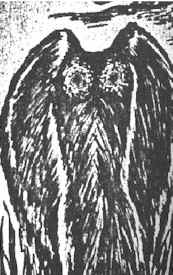
Mothman (LEFT), drawing by Maddie, young 16 years old artist, who wasn't born yet in 1966 and isn't from the area, who never saw the Mothman. The same drawing is found elsewhere as a drawing made by witnesses...

disturbed1maddie86.tripod.com/contact_me.htm


Schemes, frauds, competitions, and dilettante rivalry:

Things become even more dubious when John Keel comes to his personal accounts of mysterious crossed phonelines, odd phone calls, people who "know too much" about him. It has been quite some time since other ufologists leaned on the matter and discovered the disturbing part of the "paranormal" inventions of his arch friend and arch enemy all the same, Gray Barker, the inventor of the men in black mythology, the first to have written already exaggerated accounts on the Pleasant Point events in a published book. Barker is known for his lack of scruples in adding purely invented mysteries to already doubtful accounts. Keel himself suggests this type explanation all along his book, the only problem is that parts of his readers and certain ufologists do not care for this when they want to demonstrate that there are no extraterrestrial on board flying saucers.

Writer John C. Sherwood, who did not bother too much at the time when Barker changed one of his science fiction stories on "interdimensional" flying saucers so that it appears as fact in Gray Barker's magazine "Saucer News." Barker told Sherwood how truth is unimportant to him, that a good fiction used as fact makes a good entertaining saucer case. In a late article entitled "Gray Barker: my friend the myths-maker" in 1998, Sherwood says:

"An interim letter, recounting his work on a book about the West Virginia "Mothman" sightings, reflects Gray's attitude about publishing fiction as nonfiction: "About half of it is a recounting of actual sightings and events in the Ohio Valley circa 1966... I think that the `true accounts' are told in an exciting way, but I have deliberately stuck in fictional chapters based roughly on cases I had heard about." Evidently, Gray had few qualms about publishing as fact fictional material deliberately contrived for release under the Saucerian Press label and for Saucer News."

That, is the true nature of these so-called "disturbing facts which saucer-crazed ufologists refuse to take into account," with good reason indeed: they are sensationalized accounts of 1966 Ohio UFO reports, improved and enhanced towards the more fantastic... and this is the stuff that the promoters of the "ultraterrestrials" and "unfathomable non-ET intelligence which creates physical illusions of extraterrestrials" will not tell you, maybe because they do not know how dubious these stories are, since they do not check their casebook.

They will never tell you the deeds of Coon, Moseley (repented saucerist and converted debunker since), Barker (resident of Virginia, as a matter of fact), Keel and others, playing games against each other, sending false letters to contactees, shooting faked UFO footage, and voicing men-in-black impressions on the phone, all this for the sake of entertainment since flying saucers can only be fun, nothing serious, or an opportunity for money and fame, all things bear no relation to fortean research, in the sense that Charles Fort meant it.

Read Keel again, here in praise of Barker's "investigations:"

"The diehard fanatics who dominated sauceriana during the early years were a humorless lot and Gray's mischievous wit baffled and enraged them. At times it baffled me, too. This towering bear of a man was very hard to 'read.' But his investigations were always thorough and uncompromising."

Mothman:

With Barker and later Keel, Mothman turns into something really fantastic. Some of the testimonies also give this impression. But why should we be unaware of the opinions of local people? These opinions were delivered in the local newspapers of that time.

According to eyewitness accounts reported by Barker and Keel, Mothman was 7 feet tall when standing. It had wings spanning 10 feet across. Some accounts mention feathers, other more bat-like wings. The recurring feature is big red glowing eyes in the dark. Some eyewitnesses were unable to recall seeing a head and that the eyes were in the shoulders. No other detail was reported, such as feet, claws, nose teeth. No wonder; the mothman was reported either at night or up the air.

Some witnesses said mothman could fly without flapping its wings, and could match the speed of an automobile trying to flee at 100 miles an hour. They say the creature rose from the ground without flapping its wings. Other witnesses said to Keel: "It was definitely a bird." (Keel 1975, 56).


It should be noted that these ufologists which are claimed to be saucermaniacs such those of NICAP were not unaware at all on the issue of confusions between alleged extraterrestrial beings and ordinary animals such as birds, back then.

It should be noted that CSICOP, the well-known association which claims "to denounce the assertions of the paranormal " provided decades after the events an ad-hoc explanation. To CSICOP people, the mothman was an owl of the Tyto Alba genre, the white barn owl. This shows CSICOPians did not investigate too much on the case, otherwise they would have heard about the sandhill crane. Tyto Alba is in fact only 36 cm maximum, and white than grey, as its name indicates it. An owl does not account for the large glowing red eyes, its call is quite familiar and cannot match the cry of the "thing," contrarily to the eerie call of the sandhill crane. Tito Alba also does not that fly fast. Instead of capitalizing on a so-called incapacity of the witnesses to recognize things for what they are, CSICOP people should rather have made the very simple effort to check the local press and they would have found there that one week after ten nocturnal observations, which are logically not easily interpretable, witnesses noted that the thing was a large bird, and local fauna specialists came out with a much better candidate than the owl.

Ultraterrestrials on the phone:

Check again John Keel, in connection with a mysterious phone call:

"At 1 A.M. on the morning of Friday, July 14, 1967, I received a call from a man who identified himself as Gray Barker from West Virginia. The voice sounded exactly like Gray's softly accented mellifluous own, but he addressed me as if I were a total stranger and carefully called me "Mr. Keel." ... He had just heard about a case which he thought I should look into. It was, he said, similar to the Derenstein case. Gray and I had visited Woodrow Derenberger together so I knew this was not the kind of mistake he would make."

Enjoy the reasoning, "it was the voice and the tone of Gray, but it was not him because it showed that it knew what we had done together, and if it were him it would not have shown that it knew what we had done together. "

But, in interview with Jim Keith, Keel admitted that Barker was behind some of Pint Pleasant hijinks: "He did a lot of the phone nonsense, and I tracked him down one it," he said.

Barker and Keel's men-in-black at Point Pleasant:

    "They can induce a girl to embroider a tapestry, or initiate a political movement to culminate in a world-war; all in pursuit of some plan wholly beyond the purview or the comprehension of the deepest and subtlest thinkers...But are They men, in the usual sense of the word? They may be incarnate or discarnate: it is a matter of Their convenience..."

    -- Aleister Crowley, mage

Admittedly, desincarnated or material beings, sometimes with the luminous eyes, sometimes of Asian type, sometimes stuttering and sometimes speaking like machines, controlling our world without any limitation, were they named Aiwass or Jack Brown V.A.L.I.S, winged or wingless... that can explain everything explain, and certainly, such beings were called upon from time immemorial to explain... just about everything. But the first real question, as far as I am concerned, is not whether they are human "the devil" or "extraterrestrial beings" or "ultraterrestrials," but "are they anything else than fictional?"

    "Al K. Bender, a UFO researcher, had been the first known victim ...he performed a certain experiment and the lurking horror came. It began with glowing blue lights. Then came the stranger with the luminous eyes in the darkened theatre, and later on a dusky street. It culminated when the Men in Black, three of them, paid him a visit..."
    -- Gray Barker, "The Silver Bridge"

Just remember or learn that when Bender told "the secret" on the occupants of the saucers, which these men-in-black urged him to tell, he explained that they were a race resembling intelligent polar bears... Some will see there that "this nonsense is the proof that these people on board the saucers are not from another planet, but I more simply see the strong indication in there that such nonsense is only ... nonsense.

At one point, two short men wearing black overcoats called on Hyre at the newspaper office. According to Hyre, they looked almost like twins and dark complexions and "Oriental" features. One of them inquired about the rash of flying saucer reports and then blurted, "What would you do if someone did order you to stop writing about flying saucers?" Later that same day, another small Asian-looking man in black visited her office. He had abnormally long fingers and an unfamiliar accent. He introduced himself as "Jack Brown," a UFO researcher, and then stuttered, "What -- would -- what would you do -- if someone ordered -- ordered you to stop? To stop printing UFO stories" He denied knowing the other two men, but claimed to be a friend of Gray Barker's.

Apparently, it was the same Jack Brown who visited several other Point Pleasant residents that day, including a woman who had seen the Mothman. Again he mentioned Gray Barker, and added that he also was a friend of Mary Hyre and John Keel. He fumbled with a large reel-to-reel tape recorder that he apparently did not know how to operate. After observing a spherical UFO with four landing gear and bottom-mounted propeller, Tad Jones reported the incident to the police. The next morning, someone had slipped a note, hand-printed in block letters, under his door. It read, "We know what you have seen and we know that you have talked. You'd better keep your mouth shut. Several days later a second note arrived via the same means. It was printed on a piece of cardboard that had been singed around the edges, and read: "...there want [sic] be another warning."

And it is with material of that stuff that we are supposed to seriously agree to Keel statements such as "the general descriptions of the vampires themselves are identical to the 'men in black.'"

Extraterrestrial:

Woodrow Derenberger, contacted by a male spaceman called Ingrid Cold, said he continued to contact him telepathically and in person. Cold came from the planet Lanulos "in the galaxy of Ganymede." Derenberger became a bit of a local celebrity, and his story fleshed itself out as time went on, he claimed to have become pregnant through intercourse with Ingrid Cold, and left to Brazil announcing that he was going on exile on planet Lanulos... Another contactee surfaced, with same claims than Derenberger. Keel does not see in that any reason to doubt the whole contactee stuff, but evidence that it is all true: after all, when two people make the same claims, it must be true, isn't it?

A commenter wrote:

"Digested by culture, the events in Pleasant Point as they are reported by John Keel nevertheless remain very odd! Is it simply of the enthusiasm and the imagination of its storyteller? Personally, I do not believe so: something abnormal must have happened at the time, but something whose real origin was probably lost forever to leave the place to the myth of the mothman, elaborated and deteriorated by the saucerian context in which its author placed it."

The comment could not be more wrong, it not correspond at all to John Keel's idea: he did in no way put the "Mothman" in a saucerian context; ont he contrary he put the saucers in a mothmanian context. He made every effort in its course to withdraw every oddities from any extraterrestrial context: it was never Keel's intention to claim that Mothman was extraterrestrial; on the contrary, he intended to deny anything extraterrestrial in saucers and monsters for the benefit of the notion of an origin described in his words in introduction and which he names "ultraterrestrial."

Admittedly, Keel says he gathered innumerable UFO sighting reports, and claims to have seen UFOs himself. Admittedly, some of its texts and initial articles can seem those of a serious and fastidious investigator. But that holds only if one wants to be unaware of all that appeared with the passing of years on the type of "investigations," the original dubious source for stories he presents as proven facts. That holds only if one persists in ignoring of that the stories have only one voucher for authenticity, namely Keel, John; that others who cross-checked the stories did establish the freedom he took with facts, the effects of the schemes of Moseley and Barker on Keel. That holds only if one does not want to read... The Mothman Prophecies, Keel's own book, which reveals well quickly, after few "first hands witness accounts" actually labeled Gray Barker, the long and endless descent of the author into the paranoia of the "mysterious phone calls," his ramblings among contactees, the false phrophecies and so on.

That is to call "investigation" what really are "stories." People of Point Pleasant saw UFOS. Sure. Dates? Time? Duration? Direction of the winds? Planes flight plans? Advertising balloons flight plans? Independent confirmations? Angular sizes? Position of Venus in the sky? Nothing of the sort is taken into consideration. Using ufology as I want it to be, one may say: "high strangeness, null reliability," and pass on all that to care for cases of the "high strangeness, high reliability" class, win which, as a matter of fact, there are no meetings with the devil neither men in black neither giant birds with red glowing eyes nor unrealized prophecies.

That is also to be unaware of the warnings that Keel himself provides on the occasion, when he says he has become too involved to keep a necessary objectivity.

As for the rest, I can admit that one wants to believe that something out of the ordinary occurred there, despite the lack of evidence, but that is because all there was drowned in a wild pile of jokes, mythomania, total ignoring of any serious and factual approach of the things, inventions, hoaxes, paranoia and rivalry/friendship between Barker, Keel, Moseley that we will undoubtedly never know anything reliable on this subject. It is not in any way the fault of the real investigators UFO phenomenon, "saucerists" such as Ruppelt, McDonald, Hynek, Keyhoe, Hall and others cannot decently be blamed for Keel's chaoctic and undeterminable fantastic.

These latter people, if there had been something really odd at Point Pleasant, would have sought out the explanation quite differently than by blaming it all on unfalsifiable ultraterrestials, and if there had been commonplace explanations, they would have probably found it. John Keel preferred to make his way there on his own, however.

Prophecies:

We then have the alleged "prophecies." Everyone is familiar with the notion that "Mothman" is supposed to have predicted the collapse of Silver Bridge. That is not correct. Actually, it was contactees friends of Barker and Keel, supposed "channellers," who made these predictions; and they appeared primarily distort. Those predictions of air crash Keel says came from an Asian looking character in a of gray dress, seated at the back of a black Cadillac limo and named Apol, which are said to have been succesfull predictions only have Keel's word to support them.

Moreover, there no was prediction of the collapse of Silver Bridge for the 15th. The prediction was that there would be a total power blackout in the entire United States at this day, which quite simply did not occur. Another prediction related to the assassination of the Pope, which was to be followed by "days of darkness and desolation," this did not happen either. Another prediction was that of the appearance of the Antichrist in Israel... Keel was to comment on all these failed prophecies that the "ultraterrestrial intelligence" is misleading "because" its goal is to mislead us. In this turn of things, what I am saying is of course not that John Keel is an investigator who faked his investigation; this all business has nothing to do with investigations. There are contactee predictions which proved to fail all the time, and a very disturbed John Keel who not sees in these failures the trademark of pure and simple inventions, but the perversity of his favorite "ultraterrestrial"an intelligence. Like it or not, it is my opinion that Keel was able to mislead himself without any help of the supernatural.

Let's not ignore the extent of the so called "prophecies" entrusted to Keel and Barker in 1967, which include: "hundreds of contactees will be the victims of the greatest manipulation of all times", "a general poisoning with fluorine will occur," "in 1968, only one oot of ten new born child will be a boy and it will be so for two generations," "an unprecedented genocide," and so on.

These are the ideas which inspired a class of speculators in believing that "UFOs are absurd; they are thus lures, we are being manipulated."

See a source of a mention often made by Jacques Vallée as of reality being a sort of "computer program," in this extract of a letter from Keel to Barker, in which he explains how he protected himself from the malevolent influence of the men in black on his brain:

"These methods, by which so far both myself and JWM [James Moseley] have not been really "bothered," have something to do with our behavior over the past few months. ... This "method" has something to do with upsetting the modis operandi [sic] of a "program," whether it be on a computer or whatever.... I was convinced that you would be the next victim of a "shush-up."

Paranoia, rivalry, hoaxes, mystification and confusion, that is the type of things that some ufologists reject, these are not "facts which disturb saucerists because they go against an extraterrestrial origin for the UFOs."


UFOs, Mothman, and Me

(EXCERPT)

by John Keel
FATE MAGAZINE

September 2007


http://www.fatemag.com/issues/2000s/2007-09article1.html
In November 1966 four young people in Point Pleasant, West Virginia, reported a chilling encounter with a seven-foot-tall monster with glowing red eyes and a ten-foot wingspan. The press labeled it Mothman, and during the next year more than 100 West Virginians would see it. If it had been just another ten-foot-tall hairy monster I would have ignored the report. After all, Bigfoot sightings were superabundant. But the West Virginia critter had wings, could take off straight up like a helicopter, and was fond of pursuing automobiles at 90 miles an hour. In short, he was my kind of weirdie.

I found Point Pleasant was a quiet little town of 6,300 people, dozens of churches and no public bars. The Mothman sightings had taken place in a desolate World War II ammunition dump on the edge of town. More intriguing, there had been countless UFO sightings up and down the Ohio River all year. Eerie diamond-brilliant lights passed over Point Pleasant every night at 8:30 on a regular schedule. I decided to do something that the Air Force and the loud-mouthed UFO buffs had never thought of doing. I decided to investigate the situation instead of just holding conversations with the witnesses.

Within a few days a much bigger picture began to evolve. The region was not only haunted by strange aerial lights, the homes of the witnesses were plagued with poltergeists and other supernatural phenomena. Television sets were burning out at an alarming rate. Telephones were going crazy, ringing at all hours of the day and night with no one on the other end. Some people were getting calls from mysterious strangers speaking a cryptic language. Black Cadillacs bearing Oriental-looking gentlemen were cruising the black hills of West Virginia.

Mothman assumed minor importance as I uncovered all these other things. I had been investigating psychic manifestations all over the world for years and I recognized the pattern here. Some UFOs were directly related to the human consciousness, just as ghostly apparitions are often the product of the percipient’s mind. There are deeply rooted psychic and psychological factors in the UFO phenomenon, and the sudden appearance of a light in the sky triggers and releases the human energy that stimulated seemingly supernatural events. We cannot define the exact nature of those lights, but we can catalog the many manifestations that accompany them and we can demonstrate how identical manifestations occur in many different frames of reference. Religious apparitions are kissin’ kin with the tall, stately Michael Rennie types that claim to come from Ganymede, Uranus, Clarion (an unknown planet on the other side of the sun) and a dozen other absurd places. The “miracle” at Fatima, Portugal, in 1917 was undoubtedly the best-documented UFO sighting of all time (70,000 witnesses) and certainly the most thoroughly investigated.

Unfortunately, those interested in flying saucers had no interest at all in psychic phenemona, and vice versa. Those who were busy trying to trap a Bigfoot frowned upon all other forms of the weird and supernatural. Yet sea serpents, Abominable Snowpersons, poltergeists, frog rainfalls, and UFOs are all interrelated. You can’t possibly investigate one without some knowledge of the others. For example, the Men in Black (MIBs) so well known in UFO lore are even better known in the histories of witchcraft and black magic. These mysterious gentlemen have been reported for a thousand years. The UFO buffs decided they were CIA agents. But another group known as superbuffs thinks the whole world is run by a secret league of wealthy men and that the MIBs are their minions. In the Far East, where belief in a “king of the world” still rides high, people think the MIBs are agents from the secret underground cities of the king. In West Virginia the MIBs passed themselves off as everything from Bible salesmen to census takers.

When I returned to New York City from that first trip to West Virginia my own telephone went beserk. At first I only had problems when I was speaking to Ivan Sanderson in New Jersey. He was on one of those freak pseudo-independent phone company lines and it was common to be drowned out by static, or have the call suddenly cut off. Ivan solved the problem by shouting obscenities into the phone. Strangely, it worked. It was not uncommon to be having a conversation with this dignified Briton when clicks and other noises would cause him to pause and then bellow, “Get off this line, you god******* son of a b****!” The line noises would cease abruptly.

My problems soon escalated. Someone would interrupt my conversations with a sound like a one-stringed guitar. The sound of an extension being picked up could be clearly heard. The telephone company ignored my complaints, naturally, until I wrote directly to the president of the company. Then fur flew. They checked out my line and happily reported that I did not have one tap on my wire—I had two! ......

Spiderman - Click image to download.

Saturday, August 29, 2009

MOTHMAN

Fair Use Notice: This page may contain copyrighted material the use of which has not been specifically authorized by the copyright owner. This website distributes this material without profit to those who have expressed a prior interest in receiving the included information for research and educational purposes. We believe this constitutes a fair use of any such copyrighted material as provided for in 17 U.S.C. § 107.


For thirteen month the entire town of Point Pleasant, West Virginia was gripped by a dark terror that culminated in a tragedy that made headlines all over the world. This is a story that contains all the elements of a modern science fiction movie but every single word is true.

Homes throughout the little towns were plagued with unearthly noises and ghostly manifestations while mysterious aerial lights traveled silently overhead seemingly on a regular schedule. Winged monsters and frightening apparitions terrified the population as automobiles stalled and telephones and TV sets ran amok. A Red Cross Bloodmobile filled with fresh blood was pursued along a darkened highway by a weird flying machine. Domestic animals were found slaughtered and mutilated in pastoral farm fields. Innocent people lived in surrealistic horror, haunted by the fearsome demonic "Bird" and besieged by legions of strange beings (some of which arrived in ordinary-looking automobiles).

-- John A. Keel, The Mothman Prophesies


MOTHMAN

As recorded in John Keel's seminal book The Mothman Prophecies, The Mothman sightings began to be reported in 1966. The red-eyed winged creature was dubbed "Mothman" by a newspaper reported, since the "Batman" TV series was at the height of its popularity. Sightings continued and fervor escalated over the following months, coinciding with a bewildering array of strange activity - including precognition, odd prophecies, UFO sightings and encounters with bizarre "Men in Black." It's one of the most puzzling and fascinating periods on record of paranormal activity focused in one geographic area. The creature itself has never been explained, although skeptics laughably suggested that it was a mis-sighting of a sand crane.

WIKIPEDIA:

The Mothman is a creature reportedly seen in the Charleston and Point Pleasant areas of West Virginia from November 12, 1966, to December 1967.Most observers describe the Mothman as a winged man-sized creature with large reflective red eyes and large moth-like wings. The creature was sometimes reported as having no head, with its eyes set into its chest. A number of hypotheses have been presented to explain eyewitness accounts, ranging from misidentification and coincidence, to paranormal phenomena and conspiracy theories.
November 15, 1966

On November 15, 1966, two young, married couples from Point Pleasant, David and Linda Scarberry and Steve and Mary Mallette, were traveling late at night in the Scarberrys' car. They were passing the West Virginia Ordnance Works, an abandoned World War II TNT factory, about seven miles north of Point Pleasant, in the 2,500 acre (10 km²) McClintic Wildlife Management Area, when they noticed two red lights in the shadows by an old generator plant near the factory gate. They stopped the car, and reportedly discovered that the lights were the glowing red eyes of a large animal, "shaped like a man, but bigger, maybe six and a half or seven feet tall, with big wings folded against its back", according to Roger Scarberry. Terrified, they drove toward Route 62, where the creature supposedly chased them at speeds exceeding 100 miles per hour.

However, as quoted in Keel's The Mothman Prophecies, the Scarberrys, despite driving more than 100 miles per hour, claimed to have noticed a dead dog on the side of the road, and in fact made such accurate note of its location that they claimed to have gone back the very next day and looked for it. Explanations for how they were able to make so accurate a mental note at a time of such great distress, or why they would go back to look for the dead dog, are not included in Keel's book. A plaque on the Mothman statue provides a version of the original legend: "On a chilly, fall night in November 1966, two young couples drove into the TNT area north of Point Pleasant, West Virginia, when they realized they were not alone." Driving down the exit road, they saw the supposed creature standing on a nearby ridge. It spread its wings and flew alongside the vehicle up to the city limits. They drove to the Mason County courthouse to alert Deputy Millard Halstead, who later said, "I've known these kids all their lives. They'd never been in any trouble and they were really scared that night. I took them seriously." He then followed Roger Scarberry's car back to the secret ex-U.S. Federal bomb and missile factory, but found no trace of the strange creature. According to the book Alien Animals, by Janet and Colin Bord, a poltergeist attack on the Scarberry home occurred later that night, during which the creature was seen several times.

November 16, 1966

The following night, on November 16, several armed townspeople combed the area around the TNT plant for signs of Mothman. Mr. and Mrs. Raymond Wamsley, and Mrs. Marcella Bennett, with her infant daughter Teena in tow, were in a car en-route to visit their friends, Mr. and Mrs. Ralph Thomas, who lived in a bungalow among the igloos (concrete dome-shaped dynamite storage structures erected during WW-II) near the TNT plant. The igloos were now empty, some owned by the county, others by companies intending to use them for storage. They were heading back to their car when a figure appeared behind their parked vehicle. Mrs. Bennett said that it seemed like it had been lying down, slowly rising up from the ground, large and gray, with glowing red eyes. While Wamsley phoned the police, the creature walked onto the porch and peered in at them through the window.

"Mothman" was an invention by an Ohio newspaper copyeditor, after the first news stories of the "Big Bird" sightings appeared. A large collection of first-hand material about the Mothman is found in John Keel's 1975 book The Mothman Prophecies, in which Keel lays out the chronology of the Mothman and what he claims to be related parapsychological events in the area, including UFO activity, Men in Black encounters, poltergeist activity, Bigfoot and black panther sightings, animal and human mutilations, precognitions by witnesses, and the December 15 1967 collapse of the Silver Bridge spanning the Ohio River.

Keel's first book was the basis of a 2002 film, The Mothman Prophecies, starring Richard Gere, Laura Linney, Debra Messing, and Will Patton, directed by Mark Pellington. A companion book called The Eighth Tower, also released in 1975, was derived from material edited from The Mothman Prophecies by the publishers. In the May-June 2002 issue of the Skeptical Inquirer, journalist John C. Sherwood, a former business associate of UFO hoaxer Gray Barker, published an analysis of private letters between Keel and Barker during the period of Keel's investigation. In the article, "Gray Barker's Book of Bunk", Sherwood documented significant differences between what Keel wrote at the time of his investigation and what Keel wrote in his first book about the Mothman reports, raising questions about the book's accuracy.

Cryptozoologist Loren Coleman, in conjunction with Sony/Screen Gems studio and as noted in the documentary film by David Grabias, "In Search of the Mothman", served as one of the fictional movie's two publicity spokespersons (Keel being the other, although Keel's involvement was limited by health concerns).

Andy Colvin, a photographer and documentary filmmaker who claims to have seen the Mothman, has produced two books and a reality series on Mothman called The Mothman's Photographer, featuring John Keel and almost 50 witnesses. Colvin's sister took a snapshot of him in 1973 that allegedly shows a Garuda in the background.

There are several theories concerning the Mothman phenomenon.
Supernatural theories

John Keel claimed that Mothman was related to parapsychological events in the area, including UFO activity, Men in Black encounters, poltergeist activity, Bigfoot and black panther sightings, animal and human mutilations, precognitions by witnesses, and the December 15, 1967 collapse of the Silver Bridge spanning the Ohio River.

Misidentified bird

One of the early theories is that the Mothman was a misidentified Sandhill Crane, which, in the late 1960s had been a problem in surrounding regions. Sandhill cranes have an average wingspan of 5.3 feet (up to 7 feet), average overall length of 39 inches and have the general appearance described, glide for long distances without flapping, and have an unusual shriek. Other theories suggest the possibility of the Mothman being a Barn Owl, an albino owl, or perhaps a large Snowy Owl (based on artists' impressions). Skeptics suggest that the Mothman's glowing eyes are actually red-eye caused from the reflection of light, from flashlights, or other light sources that witnesses may have had with them.

Hoaxes
In Episode 2 of the short-lived TV series X-Testers, the researchers on the show attempted various ways to duplicate various photographs of what is said to be Mothman on bridges. The researchers concluded that a recent photo of an unidentified object on the bridge is possibly just a black garbage bag, and earlier photos are possibly just camera tricks.

The Mothman Festival is a weekend long event held in Point Pleasant, West Virginia occurring on the 3rd weekend every September. There are a variety of events that go on during the festival such as Guest Speakers, Vendor Exhibits, and Hayride Tours focusing on the notable areas of Point Pleasant, West Virginia.

The Mothman vinyl line has been created by renowned artist David Horvath, co-creator of Uglydolls. He has created a line of Japanese vinyl figurines that currently numbers seven. The figurines include Eye Witness, TNT Area, Silver Bridge, Point Pleasant, Indrid Cold, Prophecy, and Chernobyl types. The figurines were produced in editions of fifty or one hundred, depending on the version. The complete set has earned a permanent place at the Mothman Museum in Point Pleasant.

MOTHMAN! The Enigma of Point Pleasant


© Copyright 2001 by Troy Taylor. All Rights Reserved.

Late in the evening of November 15, two young married couples had a very strange encounter as they drove past an abandoned TNT plant near Point Pleasant, West Virginia. The couples spotted two large eyes that were attached to something that was "shaped like a man, but bigger, maybe six or seven feet tall. And it had big wings folded against its back". When the creature moved toward the plant door, the couples panicked and sped away. Moments later, they saw the same creature on a hillside near the road. It spread its wings and rose into the air, following with their car, which by now was traveling at over 100 miles per hour. "That bird kept right up with us," said one of the group. They told Deputy Sheriff Millard Halstead that it followed them down Highway 62 and right to the Point Pleasant city limits. And they would not be the only ones to report the creature that night. Another group of four witnesses claimed to see the “bird” three different times!

Another sighting had more bizarre results. At about 10:30 on that same evening, Newell Partridge, a local building contractor who lived in Salem (about 90 miles from Point Pleasant), was watching television when the screen suddenly went dark. He stated that a weird pattern filled the screen and then he heard a loud, whining sounds from outside that raised in pitch and then ceased. “It sounded like a generator winding up” he later stated. Partridge’s dog, Bandit, began to howl out on the front porch and Newell went out to see what was going on.

When he walked outside, he saw Bandit facing the hay barn, about 150 yards from the house. Puzzled, Partridge turned a flashlight in that direction and spotted two red circles that looked like eyes or “bicycle reflectors”. They moving red orbs were certainly not animal’s eyes, he believed, and the sight of them frightened him. Bandit, an experienced hunting dog and protective of his territory, shot off across the yard in pursuit of the glowing eyes. Partridge called for him to stop, but the animal paid no attention. His owner turned and went back into the house for his gun, but then was too scared to go back outside again. He slept that night with his gun propped up next to the bed. The next morning, he realized that Bandit had disappeared. The dog had still not shown up two days later when Partridge read in the newspaper about the sightings in Point Pleasant that night.

One statement that he read in the newspaper chilled him to the bone. Roger Scarberry, one member of the group who spotted the strange “bird” at the TNT plant, said that as they entered the city limits of Point Pleasant, they saw the body of a large dog lying on the side of the road. A few minutes later, on the way back out of town, the dog was gone. They even stopped to look for the body, knowing they had passed it just a few minutes before. Newell Partridge immediately thought of Bandit, who was never seen again.

On November 16, a press conference was held in the county courthouse and the couples from the TNT plant sighting repeated their story. Deputy Halstead, who had known the couples all of their lives, took them very seriously. “They’ve never been in any trouble,” he told investigators and had no reason to doubt their stories. Many of the reporters who were present for the weird recounting felt the same way. The news of the strange sightings spread around the world. The press dubbed the odd flying creature “Mothman”, after a character from the popular Batman television series of the day.

The remote and abandoned TNT plant became the lair of the Mothman in the months ahead and it could not have picked a better place to hide in. The area was made up of several hundred acres of woods and large concrete domes where high explosives were stored during World War II. A network of tunnels honeycombed the area and made it possible for the creature to move about without being seen. In addition to the manmade labyrinth, the area was also comprised of the McClintic Wildlife Station, a heavily forested animal preserve filled with woods, artificial ponds and steep ridges and hills. Much of the property was almost inaccessible and without a doubt, Mothman could have hid for weeks or months and remained totally unseen. The only people who ever wandered there were hunters and fishermen and the local teenagers, who used the rutted dirt roads of the preserve as “lover’s lanes”.

Very few homes could be found in the region, but one dwelling belonged to the Ralph Thomas family. One November 16, they spotted a “funny red light” in the sky that moved and hovered above the TNT plant. “It wasn’t an airplane”, Mrs. Marcella Bennett (a friend of the Thomas family) said, “but we couldn’t figure out what it was.” Mrs. Bennett drove to the Thomas house a few minutes later and got out of the car with her baby. Suddenly, a figure stirred near the automobile. “It seemed as though it had been lying down,” she later recalled. “It rose up slowly from the ground. A big gray thing. Bigger than a man with terrible glowing eyes.”

Mrs. Bennett was so horrified that she dropped her little girl! She quickly recovered, picked up her child and ran to the house. The family locked everyone inside but hysteria gripped them as the creature shuffled onto the porch and peered into the windows. The police were summoned, but the Mothman had vanished by the time the authorities had arrived.

Mrs. Bennett would not recover from the incident for months and was in fact so distraught that she sought medical attention to deal with her anxieties. She was tormented by frightening dreams and later told investigators that she believed the creature had visited her own home too. She said that she could often hear a keening sounds (like a woman screaming) near her isolated home on the edge of Point Pleasant.

Many would come to believe that the sightings of Mothman, as well as UFO sightings and encounters with “men in black” in the area, were all related. For nearly a year, strange happenings continued in the area. Researchers, investigators and “monster hunters” descended on the area but none so famous as author John Keel, who has written extensively about Mothman and other unexplained anomalies. He has written for many years about UFO’s but dismisses the standard “extraterrestrial” theories of the mainstream UFO movement. For this reason, he has been a controversial figure for decades. According to Keel, man has had a long history of interaction with the supernatural. He believes that the intervention of mysterious strangers in the lives of historic personages like Thomas Jefferson and Malcolm X provides evidence of the continuing presence of the “gods of old”. The manifestation of these elder gods comes in the form of UFO’s and aliens, monsters, demons, angels and even ghosts. He has remained a colorful character to many and yet remains respected in the field for his research and fascinating writings.

Keel became the major chronicler of the Mothman case and wrote that at least 100 people personally witnessed the creature between November 1966 and November 1967. According to their reports, the creature stood between five and seven feet tall, was wider than a man and shuffled on human-like legs. Its eyes were set near the top of the shoulders and had bat-like wings that glided, rather than flapped, when it flew. Strangely though, it was able to ascend straight up “like a helicopter”. Witnesses also described its murky skin as being either gray or brown and it emitted a humming sound when it flew. The Mothman was apparently incapable of speech and gave off a screeching sound. Mrs. Bennett stated that it sounded like a “woman screaming”.

John Keel arrived in Point Pleasant in December 1966 and immediately began collecting reports of Mothman sightings and even UFO reports from before the creature was seen. He also compiled evidence that suggested a problem with televisions and phones that began in the fall of 1966. Lights had been seen in the skies, particularly around the TNT plant, and cars that passed along the nearby road sometimes stalled without explanation. He and his fellow researchers also uncovered a number of short-lived poltergeist cases in the Ohio Valley area. Locked doors opened and closed by themselves, strange thumps were heard inside and outside of homes and often, inexplicable voices were heard. The James Lilley family, who lived just south of the TNT plant, were so bothered by the bizarre events that they finally sold their home and moved to another neighborhood. Keel was convinced that the intense period of activity was all connected.

And stranger things still took place..... A reporter named Mary Hyre, who was the Point Pleasant correspondent for the Athens, Ohio newspaper the Messenger, also wrote extensively about the local sightings. In fact, after one very active weekend, she was deluged with over 500 phone calls from people who saw strange lights in the skies. One night in January 1967, she was working late in her office in the county courthouse and a man walked in the door. He was very short and had strange eyes that were covered with thick glasses. He also had long, black hair that was cut squarely “like a bowl haircut”. Hyre said that he spoke in a low, halting voice and he asked for directions to Welsh, West Virginia. She thought that he had some sort of speech impediment and for some reason, he terrified her. “He kept getting closer and closer to me, “ she said, “ and his funny eyes were staring at me almost hypnotically.”

http://www.animationbuddy.com/Animation/Science_and_Body/Eyes/red_eyes.gif

Alarmed, she summoned the newspaper’s circulation manager to her office and together, they spoke to the strange little man. She said that at one point in the discussion, she answered the telephone when it rang and she noticed the little man pick up a pen from her desk. He looked at it in amazement, “as if he had never seen a pen before.” Then, he grabbed the pen, laughed loudly and ran out of the building.

Several weeks later, Hyre was crossing the street near her office and saw the same man on the street. He appeared to be startled when he realized that she was watching him, turned away quickly and ran for a large black car that suddenly came around the corner. The little man climbed in and it quickly drove away.

By this time, most of the sightings had come to an end and Mothman had faded away into the strange “twilight zone” from which he had come... but the story of Point Pleasant had not yet ended. At around 5:00 in the evening on December 15, 1967, the 700-foot bridge linking Point Pleasant to Ohio suddenly collapsed while filled with rush hour traffic. Dozens of vehicles plunged into the dark waters of the Ohio River and 46 people were killed. Two of those were never found and the other 44 are buried together in the town cemetery of Gallipolis, Ohio.


During Christmas week, a short, dark-skinned man entered the office of Mary Hyre. He was dressed in a black suit, with a black tie, and she said that he looked vaguely Oriental. He had high cheekbones, narrow eyes and an unidentified accent. He was not interested in the bridge disaster, she said, but wanted to know about local UFO sightings. Hyre was too busy to talk with him and she handed her a file of related press clipping instead. He was not interested in them and insisted on speaking with her. She finally dismissed him from her office.

That same night, an identically described man visited the homes of several witnesses in the area who had reported seeing the lights in the sky. He made all of them very uneasy and uncomfortable and while he claimed to be a reporter from Cambridge, Ohio, he inadvertently admitted that he did not know where Columbus, Ohio was even though the two towns are just a few miles apart.

So who was Mothman and what was behind the strange events in Point Pleasant?

Whatever the creature may have been, it seems clear that Mothman was no hoax. There were simply too many credible witnesses who saw “something”. It was suggested at the time that the creature may have been a sandhill crane, which while they are not native to the area, could have migrated south from Canada. That was one explanation anyway, although it was one that was rejected by Mothman witnesses, who stated that what they saw looked nothing like a crane.

But there could have been a logical explanation for some of the sightings. Even John Keel (who believed the creature was genuine) suspected that a few of the cases involved people who were spooked by recent reports and saw owls flying along deserted roads at night. Even so, Mothman remains hard to easily dismiss. The case is filled with an impressive number of multiple-witness sightings by individuals that were deemed reliable, even by law enforcement officials.

But if Mothman was real... and he truly was some unidentified creature that cannot be explained, what was behind the UFO sightings, the poltergeist reports, the strange lights, sounds, the “men in black” and most horrifying, the collapse of the Silver Bridge?

John Keel believes that Point Pleasant was a “window” area, a place that was marked by long periods of strange sightings, monster reports and the coming and going of unusual persons. He states that it may be wrong to blame the collapse of the bridge on the local UFO sightings, but the intense activity in the area at the time does suggest some sort of connection. Others have pointed to another supernatural link to the strange happenings, blaming the events on the legendary Cornstalk Curse that was placed on Point Pleasant in the 1770's.

And if such things can happen in West Virginia, then why not elsewhere in the country? Can these “window” areas explain other phantom attackers, mysterious creatures, mad gassers and more that have been reported all over America? Perhaps they can, but to consider this, we have to consider an even more chilling question... where will the next “window” area be? It might be of benefit to study your local sightings and weird events a little more carefully in the future!

© Copyright 2001 by Troy Taylor. All Rights Reserved.

In 1967, the Silver Bridge between Point Pleasant, WV, and Gallipolis, OH, collapsed killing 46 people. This, the first major collapse since the Tacoma Narrows Bridge (7 Nov 1940) prompted national concern, leading to National Bridge Inspection Standards in the Federal-Aid Highway Act of 1968. Instead of wire cables, the 700-ft suspension bridge deck hung from a chain of linked eyebars. The dogbone-shaped eyebars had a hole, or "eye," in each end and were linked in pairs by massive pins. When an eyebar pin on one side of the bridge failed its chain dropped below the roadway. The chain on the other side was then unable by itself to support the weight of the entire structure, resulting in complete failure.


Mason County Courthouse

Point Pleasant, County Seat of Mason County, West Virginia-- Originally chartered in 1794 and incorporated 1833. Named after Camp Point Pleasant, established there by General Andrew Lewis at the time of his famous battle with the Indians in 1774. Built on the site of the bloodiest battle ever fought between the Indians and white settlers: the Battle of Point Pleasant, October 10, 1774, the chief event of Dunmore's War, a forerunner of the American Revolution. Location of Tu-endie-wei State Park. Burial place of Cornstalk, Indian Chieftain, and Ann Bailey, celebrated in annals of the border.

MOTHMAN - MYTH OR MONSTER?

by M.J. Graeber
MAGONIA Supplement Number 46, March 17, 2003

http://www.users.waitrose.com/~magonia/ms46.htm

AMONGST the many urban legends that have sprung up in the United States over the years, perhaps the story of a strange winged creature that was encountered during the 1960s near Point Pleasant, West Virginia is the most fascinating.
The numerous observations of the thing known as Mothman were widely reported by the press, on radio, and over TV news networks throughout the nation; and a book about the creature, written by investigative journalist John Keel, is said to be something of a Fortean classic. Moreover, a motion picture based on Mr Keel's writings, starring veteran film actor Richard Gere, was released on 25 January 2002.

But the many close encounters and fleeting observations of Mothman do not appear to be similar to other urban legend reports such as ghostly sightings of Midnight Mary, the Jersey Devil, or even encounters with alligators splashing about in the sewers of New York City. For the Mothman observations are also said to have a "psychic component" and, although it seems a bit unclear as to why or how the Silver Bridge disaster is linked to the psychic aspect of the Mothman mystery, there were rumours that some Point Pleasant residents had experienced premonitions of impending disaster. Indeed, strange forewarnings of various fateful future events (including the attempted assassination of the Pope) were channelled to Mr Keel by several contactees. Apparently, these psychic warnings reached their peak when the Silver Bridge that spanned the Ohio River near Point Pleasant, West Virginia, suddenly collapsed on 15 December 1967, killing 46 people.For this and many other reasons, Mr Keel's book is entitled The Mothman Prophecies and, although it is obvious that the creature itself did not actually converse with its primary witnesses (early reports indicated that Mothman squeaked like a large mouse), it is thought that the mere sight of the creature may have somehow triggered the psychical remote viewing capabilities of some of the individuals who came into close proximity with it.

Moreover, there were even rumours that two mothmen had been spotted beneath the Silver Bridge just before it toppled. According to the story, they were beating their enormous wings in unison and the combined resonant sound had violently vibrated the structure causing it to collapse. But engineers who examined the fallen span felt that it had succumbed to the combined effects of being of antiquated design (it was built in 1928), increased traffic and structural fatigue.

Dog gone!?
In addition to the sightings of Mothman, there was also a rash of dog disappearances, and strange cattle and small animal mutilations associated with the creature. In one instance Mothman was said to have stopped chasing a carload of young people to gaze upon a dead dog lying in the road. Similarly, in 1909 the Jersey Devil was said to have devoured small dogs and chickens, and the snatching of various pets and livestock has also been linked to UFOs and mystery airship sightings dating back to the 1890s.

Bandwaggoning effects(?)
Of course, many rumours have sprung up about Mothman since the 1966 sightings. Some are pure fabrications, while others appear to be simple distortions of the original reports. So, too, there exists a great deal of speculation regarding the creature's true appearance, its activities, and its probable origin.

In fact, to date, it appears that a definitive illustration of the creature hasn't been established and, although most people say that Mothman was grey in colour, there is a report of his having a greenish, scaly skin tone, something like a reptile. In one report, Mothman was said to have pecked at a car window so it's difficult to know if this pecking was typical of bird-like behaviour or if it was similar to that of an insect's reaction to the car's interior lighting (i.e., like a moth drawn to a flame).

Interestingly, several Mothman investigators have suggested that some of the reports sound remarkably like misidentifications of a very large bird. They suggest that a sandhill crane seen from a distance, especially in poor lighting conditions, might look like a man wearing a grey coat, and if the six-foot tall crane should have momentarily unfurled its wings, it seems reasonable to suspect that the misidentified man might have been thought to have huge wings too. Moreover, cranes often use their long powerful legs to spring into the air when taking wing, and it may be that this sort of lift-off technique was thought to be "helicopter-like" by some of the Mothman witnesses. After all, the relatively rare sandhill cranes are not commonly seen in north-eastern American States such as West Virginia. But, enough speculation on the creature for the moment; what in the world did the witnesses actually report seeing?

One of the first sightings of Mothman occurred near Point Pleasant on the night of 15 November 1966, when two young married couples were driving along on a road outside the city limits. Apparently, they saw the seven-foot tall creature standing near an abandoned power plant not too far from a defunct munitions dump known as the TNT area. It had enormous wings and was ashen grey in colour. After being momentarily mesmerised by the creature's large, glowing red eyes (which one witness described as looking like "bicycle reflectors"), the witnesses frantically sped back towards Point Pleasant with the creature swiftly flying along in pursuit of their car.
According to the witnesses, the creature never seemed to flap its ten-foot wide wings as it followed them at speeds which they thought were approaching 100 mph. Fortunately, the creature broke off its pursuit and the terrified group rushed into Mason County Court House and reported the strange encounter to Deputy Sheriff Millard Halstead. Halstead, not knowing quite what to make of the story, returned to the TNT area with the young folks, but failed to catch a glimpse of the creature.

This would not be his last visit to the old explosives site or the abandoned power plant as reports of encounters with the winged monster started to mount.
Interestingly, the initial reports described the creature as looking like "a large bird", but a reporter covering the story dubbed the creature "Mothman" because Batman was a popular TV show at the time and, somehow, the name just stuck.
Of course, there were some discrepancies in the reports involving the creature's appearance, but its enormous reflective eyes, wingspan, height and colouring appeared to be rather consistent.
Another encounter with the thing happened the next day (16 November) when a group of people drove out near the old TNT area to visit the Ralph Thomas family. This group consisted of an adult male, two women and a small child. As they parked their car in front of the Thomas' home one woman reported that a big grey thing seemed to rise up from the ground near the car (as if it had been lying in the grass). It was larger than a man, she thought, and had huge red eyes.

The group momentarily froze in their tracks at the sight of the monster and one woman dropped the child she was holding in her arms, then, after quickly picking the child up, they dashed into the house. Once inside, the shaken group and the Thomas children locked the doors and peered out of the windows (Mr and Mrs Thomas were not home at the time). According to the witnesses' continuing account, Mothman then ambled up upon the porch and gazed through a window at them. By the time the police arrived on the scene Mothman had vanished once more.

According to Daniel Cohen, author of Creatures from UFOs (Simon and Schuster, New York, NY, 1975), "Prior to November 16th, 1966, a number of UFOs had been observed in the Point Pleasant area. In fact. for years there had been a large number of UFO sightings reported throughout the state of West Virginia." Yet, Mr Cohen finds it to be a bit unusual that the Mothman sightings have been speculatively linked to UFOs, since no one actually reported observing the creature coming out of (or entering) a flying saucer. Mr Cohen feels that people probably just "assume" that Mothman was somehow connected to the UFO sightings because the sightings of each happened to have coincided (both geographically and temporally). Of course, it's also true that some crop circle formations as well as cattle mutilations have also been linked to UFO activity, when no one actually saw a UFO in the vicinity at the exact times of such incidents; but in other instances, strange aerial lights (UFOs) and mysterious black helicopters have been reported along with cattle mutilations and the appearances of crop circles.

Moreover, according to Fate magazine's David F. Goodwin, reported sightings of men in black (MIBs) in and around the Point Pleasant area at the time of the Mothman encounters tended to add even more mystery to the overall story and this, too, may bolster suspicions that Mothman was, indeed, of extraterrestrial origin.

The monster
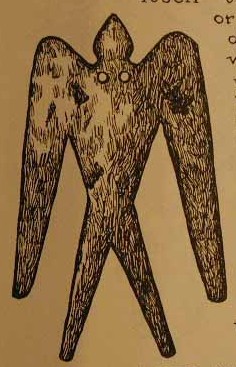
The illustrations of the creature that have been published vary quite a bit, and on Mr John Keel's book jacket the creature looks like a comic-book superhero of sorts (i.e., a spiderman with enormous insect-like wings). The creature's wings appear to be upright and independent of its arms, and it has a normal-sized head sitting upon broad and muscular shoulders. The illustration does not in the least bit look "bird-like" nor does it appear to be particularly terrifying to behold.

In Mr Daniel Cohen's book, Mothman appears to be more batman-like and it's difficult to determine if its head, which also appears to be normal in size, is hooded or masked - this Mothman has very long spindly arms that appear to be supporting his unfurled bat-like wings or cape.
In both illustrations the creature's costume is tight fitting. But in other sketches the creature looks like a headless man with enormous bug-like eyes situated between its shoulders. Interestingly, insectoid creatures have reportedly been seen in UFOs along with humanoids and several other types of alien entities.

More sightings

Both Thomas Ury and Connie Carpenter described Mothman as being tall and grey. Ury said he thought that the creature looked like a man wearing a grey coat, and each reported seeing its gigantic wings unfold from behind its back. Interestingly, Ury and Carpenter were pursued by the creature while in their cars and Carpenter described its face as being "horrible" like something straight out of a science fiction movie. But others in Point Pleasant would suspect that Mothman was actually an incarnate manifestation of a 200-year old curse upon their community.

The curse
In 1774, a Shawnee chieftain named "Cornstalk" was mortally wounded in a battle with colonial militiamen at the confluence of the Ohio and Kanawha Rivers (which is now known as Point Pleasant). Apparently, Chief Cornstalk was tricked into an ambush by the fork-tongued governor of Virginia (Lord Dunmore) who desired to quash anti-British sentiments amongst the colonists by inciting fears and hatred against the Native Americans of the region.

Chief Cornstalk thought he was meeting with the colonists to make a treaty and is said to have uttered a dreadful curse upon the land with his dying breath. Since that time, numerous catastrophes of varying magnitude such as fires and floods have occurred in Point Pleasant, causing generation after generation of townspeople to wonder if Cornstalk's curse had truly come to pass, even to the point where the appearance of Mothman was believed by some to be a malevolent incarnation of the curse that brought down the Silver Bridge.

Another encounter?
One rainy night in August 1973, my daughter Tina (then aged 13) accidentally dropped a sewing needle on the floor and didn't realise that she had until she stepped on it as she was heading off to bed. Unfortunately the needle, which was nestled in the pile of a shag rug, broke off deep in her right foot and, although I was able to remove about a half-inch piece of it, yet another piece remained deeply embedded and required professional medical attention.

At first, Tina seemed uncertain that a little piece of the needle was till lodged in her foot, so it was not until two or three hours later that she decided the pain she was experiencing was not an after-effect of the initial injury. As I recall, at was about 1:00 a.m. that we started our trip to the emergency room of Mercy Fitzgerald Hospital in Darby, Pa., which was located about six or seven miles from our home.
It was very foggy that night and a light misty rain coated the windscreen as we began our trek. We didn't encounter too much traffic as we travelled along Woodland Avenue and left the city limits of Southwestern Philadelphia. The misty drizzle continued to fall and, naturally, I was driving fairly slowly as visibility was quite limited.

Tina was a little apprehensive about how the emergency room doctor might remove the needle and I was attempting to assure her that he or she would make it as painless as possible for her (they actually removed the needle through the top of her foot).

Traffic lights seemed to suddenly appear from out of nowhere through the misty shroud and the occasional street light appeared to be a luminous cone that slipped by like a buoy in a foggy harbour.

Suddenly, a red light pierced the mist and I brought my car to a halt at an intersection. The faint outline of a neon sign illuminated a tavern's window and reflected off the wet pavement. Two street lights also illuminated a section of the roadway just beyond the tavern's lights and the shadow of a strange bipedal figure caught in the light fanned out across the ground revealing what looked like an enormous headless man with huge shoulders, elongated arms, and gigantic wings. My daughter instinctively slid across the seat closer to me and grabbed my arm while asking, "Daddy . . . what is it?"

Of course I, too, was completely astonished by the spectacle as the shadow started to recede and the figure it belonged to emerged. The headless monster was about seven feet tall, and moved with a shuffling gait. It had two bright white vertical eyes, lit up like those of some animal caught in a car's headlights. Its wings were translucent or light grey in colour and looked as if they were flaring out - but they were not fully extended as if the thing intended to take flight. The monster's arms seemed to dangle low against its body and its hands looked like claws, because the thing had passed through the first street light so quickly it was now almost completely silhouetted against the light and headed straight towards us.
I quickly looked about and revved my car's engine in order to escape, and my action seemed to startle the monster as my tyres squealed and the car fish-tailed on the rain-soaked roadway.

As we passed the figure, I momentarily caught a glimpse of it in our headlights and realised that the thing wasn't a monster at all - but an early-morning hiker with a large backpack-bedroll strapped above his shoulders. He was wearing a transparent (plastic) poncho and had attached his bedroll to his backpack's frame with straps that also had bicycle reflectors affixed to them.

My daughter and I were both so relieved and astonished by our optical discovery that we immediately broke into nervous laughter and completely forgot about Tina's foot for a moment or two. This had been an extremely scary experience and, if we had not had the opportunity to better observe the figure as we sped by it, we may never have realised that our "Mothman" was merely a hiker dressed for inclement weather. Come to think of it, at the time of the incident Tina and I were totally unaware of the Mothman legend and, of course, neither of us had read John Keel's or Gray Barker's books about the creature's many appearances or the collapse of the Silver Bridge.

Still unknown
Was Mothman a misidentified swamp bird, a ufonaut, the embodiment of a Shawnee chieftain's dying curse, a hiker, or a will-o'-the-wisp born of a localised hysteria that gripped Point Pleasant much like the sightings of the Jersey Devil did in 1909? In that case, people locked their doors and windows, closed businesses, and armed themselves. Similar behaviour has recently been associated with the appearances of an ill-defined creature simply known as Monkey Man in New Delhi, India, where a roving band of over-zealous young men armed with clubs mistakenly attacked a late-night delivery man working in their community.
In the area surrounding Point Pleasant at the time of the Mothman encounters a large vulture was shot, as was an Arctic snowy owl that must have scared the wits out of the farmer that brought it down. After all, it looked sort of light grey in colour, and had round reflective eyes.

Summary

Sightings of Mothman suddenly dropped off after the 15 December 1967 collapse of the Silver Bridge, and no one seems to know why, but one wonders if Mothman's appearances somehow caused (or triggered) some folks to experience prophetic visions of the bridge's impending doom? Perhaps we will never know for sure, but this much seems certain - those who actually saw Mothman appear to be unimpressed with the many attempts to prosaically identify the creature, and it is clear that their encounters with the thing had a profound impact upon them. So it is that Mothman slips into the history of Point Pleasant while steadily growing into a modern-day legend and a rather remarkable piece of American folklore.


USA Today

'Mothman' sightings will continue
01/23/2002
By Stephen Schaefer, USA TODAY
Melissa Moseley, AP

Until now, the Mothman has been known only to a devoted, cultlike few. That's certain to change with The Mothman Prophecies, out Friday and starring Richard Gere. The otherworldly 7-foot, red-eyed, winged apparition known as Mothman might even become a pop-culture totem, like Big Foot.

John A. Keel's The Mothman Prophecies is based on paranormal events the author experienced and studied in Point Pleasant, W.Va., in 1966-67, while writing about UFOs for Playboy. It's not giving away too much to say the residents were hearing and seeing things, culminating in a bridge collapse that cost 46 lives.

Because the thriller is advertised as "based on true events," Keel, Mothman director Mark Pellington and Mothman expert Loren Coleman (featured at 10 ET/PT Wednesday night on the FX channel documentary Searching for the Mothman) reveal the "truths" behind the film. "Maybe we should have said 'inspired by true events,' " a cheerful Pellington says.

Says Coleman, who has published a book on the "dark and sinister" subject: "Pellington's made it a psychological thriller and not a monster movie. With this movie, Point Pleasant will become like Roswell and explode with tourism." In the film, Washington Post reporter John Klein, played by Gere, investigates the strange goings-on. "That's fiction," Pellington says.

But a few truths are out there:

* Frightened teens. "That came right out of the book," Pellington says. "Keel describes two kids who had sex who felt this thing attack them."

Says Coleman, who interviewed one of them: "A huge creature about 7 feet tall with huge wings and red eyes shuffled toward them, they ran to the car, and at 100 mph drove back to Point Pleasant. They could see the creature flapping right behind them."

* Sad sack. Will Patton (TV's The Agency) plays a man going nuts from his encounters with the Mothman, who takes the form of Gere's Klein. "He's invented, a composite of two of the major witnesses who had intense Mothman manifestations," Pellington says. "Like Alan Bates says to Klein in the film, 'It's perception, John. They appear differently to everybody. A man, a voice, a light, a monster.' That I wrote."

* The scientist. Bates (Gosford Park) plays Alexander Leek, driven mad by his Mothman encounter. Leek is fictional, but the name is a clue: It's Keel spelled backward.

Says Keel, 72: "The book tells what happened to me. Alan Bates gives a Keel speech, almost word for word, of what I've been saying for years."

* The tragedy. As for the Silver Bridge collapse, "that happened in 1967," Pellington says. "It was explained as metal fatigue. Once the bridge came down, the phone calls and sightings stopped. That's why it became legendary and why people blamed a force." Coleman says that is fiction. "Sightings continue."

The real Keel, unlike Gere's Klein, was nowhere near the bridge that day. "I knew the exact time it was going to happen, but you couldn't warn anyone because it might cause a panic, and it might not be true." He knew because "I was getting these damned mysterious phone calls, just like in the movie."

The film has 36 people dying, not 46, but the studio didn't "want to kill too many," Pellington says. "My father's football number was 36, and 40 was too many."


MOTH LINKS

cpsi-paranormal mothman page: http://www.cpsi-paranormal.org/Mothman.html

MOTHMAN LIVES DOT COM: http://www.mothmanlives.com/

LinkMOTHMAN MUSEUM MYSPACE PAGE: www.myspace.com/mothmanmuseum

EYES OF THE MOTHMAN (official site of the documentary film): http://www.eyesofthemothman.com/mothintro.html

MOTHMAN CENTRAL: http://www.paraview.com/mothman_central.htm


MOTHMAN from Answers Dot Com
http://www.answers.com/topic/mothman

Winged humanoid creature reported in West Virginia from November 1966 to December 1967, along with strange lights, apparitions of men in black, and other occult phenomena supposedly connected with UFOs. These phenomena culminated on December 15, 1967, with the collapse of the Silver Bridge across the Ohio River at Point Pleasant. The name "Mothman" was the inspiration of a newspaper editor, who derived it from the Batman comic book hero, then the subject of a popular television series.

In his book The Mothman Prophecies: An Investigation Into the Mysterious American Visits of the Infamous Feathery Garuda (1975), author John A. Keel suggests that these and other occult appearances might be the work of evil entities. The term "garuda" derives from ancient Hindu mythology, where Garuda is king of the birds, half-man, half-bird, the vehicle of the god Vishnu. In the religious epic the Ramayana, Jatayu is the son of Vishnu's Garuda, and dies fighting against the demon Ravana in an attempt to prevent the abduction of the princess Sita.

In February 1976, three schoolteachers in Texas reported sightings of a "Big Bird," discussed in Grey Barker's Newsletter (no. 7, March 1977). An earlier issue of the newsletter (no. 5, March 1976) had reported a more bizarre claimed abductee experience with "Vegetable Man," pictured as a triffid-style animated tree.

UFO authority Jacques Vallee compared Mothman and similar apparitions to Springheeled Jack, the legendary creature of early nineteenth-century Britain, who attacked travelers and terrified women with his giant leaps and diabolical appearance. Mothman was said to chase motorists and to frighten women. Witnesses stated that he was large, gray in color, without feathers, and with eyes that glowed red. It has been suggested that Mothman is a UFO phenomenon.

Sources:
Clark, Jerome. Encyclopedia of Strange and Unexplained Phenomena. Detroit: Gale Research, 1993.
Haining, Peter. The Legend and Bizarre Crimes of Springheeled Jack. London: Frederick Muller, 1977.
Keel, John A. The Mothman Prophecies: An Investigation Into the Mysterious American Visits of the Infamous Feathery Garuda. New York: Saturday Review Press/Dutton, 1975. Reprint, New York: New American Library, 1976. Reprinted as Visitors From Space: The Astonishing True Story of the Mothman Prophecies. St. Albans, England: Panther, 1976.


Mothman & The Thunderbird

August 2002 by Daniel V. Boudillion
Revised & Updated June 2003
http://www.boudillion.com/Moth/mothman.html

The Mothman is one of the strangest and most terrifying of anomalous creatures ever to be recorded in America. Between November 12, 1966 and December 15, 1967, it terrorized citizens in the Point Pleasant area of West Virginia. It was said to have been encountered by at least 100 people over the course of that year. According to author John A. Keel (The Mothman Prophecies, 1975) who was on hand investigating the reports during the time of the sightings, the creature was reported to be roughly man-shaped, either grey or brown, and between five and seven feet tall. Its body was wider than a man's. It did not appear to have a head, but rather its "eyes" were set on the upper chest. These "eyes" were very large, and alternately described as glowing red lights, or a reflected red like a bicycle reflector. (Glowing red eyes are the surest sign of a paranormal entity.) When it walked it shuffled on what appeared to be human-like legs, but no feet were ever observed. Rather than arms it had bat-like wings which it did not flap. It was always seen to glide. The non-flapping of the wings, even in ascent, is particularly disturbing. Indeed, it was reported to regularly ascend straight up like a helicopter - and again be it noted, without any wing-action. (In regards to the wings, John Keel determined that a man the size and heft of the Mothman would require 24 foot wings to be able to glide.) It was fast in flight, able to pace cars going over 100 miles an hour. In flight it emitted a humming sound and often emitted a "mouse-like squeaking." Occasionally it was heard to also emit a screeching sound something like a woman screaming. (This "woman screaming" sound is common among anomalous creatures, particularly the Bigfoot creatures.) No one who saw it was indifferent to the creature - it struck terror into the hearts of all its viewers.


Thunderbird Artifact:

On June 15, 2002 I was visiting the Fruitlands Museum in Harvard Massachusetts. While in the Indian Museum, I noticed an artifact that bore a startling resemblance to Mothman descriptions. This artifact is ten inches tall and made of copper sheet. It was recovered in Amoskeag Falls, Manchester, New Hampshire, and was probably fashioned from a copper kettle acquired through trade with Europeans during the early Contact Period, circa 1550-1630 A.D. It is attributed to the Pennacook Indians and labeled "Thunderbird." The main difference between the Mothman descriptions and the Thunderbird artifact is that the artifact is crafted with a head, while the Mothman is typically described as having no head. The general body shape - other then the head discrepancy - is identical. The most striking similarity is the "eye" placement. The Thunderbird artifact has two holes placed on the upper chest, same as Mothman descriptions. Presently, these "eyes" on the Thunderbird artifact are being used as string holes to lace the figure to a museum stand.

I inquired of the Museum Staff if the holes were meant as "eyes", or were lacing holes. They did not know, but gave their opinion that as "eyes", they were very compelling. I also asked if the holes were part of the original creation or were added later as lacing holes, but the staff was unable to provide information on this. A New England Koasek Abenaki who is familiar with both this item and with Thunderbird lore states that, "the two holes bored into the copper at the 'chest' would have had a braintan lace knotted through them to suspend the ornament/talisman from the wearer's neck." He goes on to state that, "We have our own theories as to the significance...." Interestingly, the Fruitlands item I examined is only a reproduction - the original is in the collection of the Peabody Museum at Harvard, catalog number 88-45-10/46959. A Native American version of its acquisition by Harvard's Peabody Museum is that it was obtained from a robber of a Pennacook Abenaki gravesite in New Hampshire.

Thunderbird Lore:

Although primarily associated with the Plains Indians, the Thunderbird was known to the Algonquin speaking peoples of New England. However, like most Native American culture in New England, little is now known of their beliefs. In regards to the Thunderbird, this much is known: it was a fearsome being and resembled a winged man or an immense bird, it caused fear and dread, and was said to actually kill and eat humans from time to time. (Jim Brandon - The Rebirth Of Pan)


Pmola


According to a New England Koasek Abenaki about the Pmola (puh-MOH-lah): "Our legends tell us of a being who appeared as a giant bird-like creature, with glowing red eyes and claws, who would swoop down on unsuspecting animals and people and carry them off ... never to be seen again. The Indian peoples of the Eastern Seaboard and Woodlands all share similar stories. Grandmothers and Mothers would caution their children to behave, lest Pmola find them unawares and carry them away."

Piasa


Jacques Marquette, a French explorer relates a petroglyph of the Piasa near Alton Illinois in 1673: "On the flat face of a high rock were painted, in red, black, and green, a pair of monsters, each as large as a calf, with horns like a deer, red eyes, a beard like a tiger, and a frightful expression of countenance. The face is something like that of a man, the body covered with scales, and the tail so long that it passes entirely round the body, over the head, and between the legs, ending like that of a fish." It was supposed to live high in a cave on the bluff. An Alton, Illinois scholar named McAdmas observed during the mid 1800s, that the name Piasa "signifies, in Illini, 'The bird that devours men.'" And indeed, it was Illini legend that children and adults were carried away and eaten.


Tlanuwa


The Cherokee ledgend of the Tlanuwa is similar of the Piasa. The Tlanuwa were a pair of immense birds said to live in a cave on the north bank of the Little Tennessee River in Blount County Tennessee. They would fly up an down the river, even coming into the villages to carry off and eat dogs and small children.


Bad8gi

According to a New England Koasek Abenaki about the Bad8gi (BAH-dohn-KEE): "I personally believe that the Thunderbird here in the East is based upon an ancient species of raptor, one that possessed a wingspan in excess of twenty feet. These gigantic preying birds were the antecedents of the Eagles that are so important to our culture and traditions today. Ancient oral traditions among the Algonquin/Abenaki tell us that these raptors rode the lightning and the thunderheads, coming up from the South, in a corridor that extends from Mexico right on up the Appalachians into New Hampshire, Vermont and Maine. I believe that the copper representation you refer to is this Thunder Being, and was made to harness the spiritual powers to benefit the wearer. Our word for this Being is Bad8gi."

[The "8" in Bad8gi is intentional. In Abenaki, the sound "OOHN" is represented by the 8 or ô, (an "o" with a circumflex.) ]

Giant Birds?

The largest bird in North America is the California Condor with a wingspan of up to nine feet. The largest known bird today is the Andean Condor with a wingspan up to 12 feet. Unlike the Andean Condor, the California is a very rare and endangered bird with only a small territory left of its once large range. But as recently as the early 1800's it still apparently lived in eastern America as well, according to Halliday's Vanishing Birds. Could Andean Condors, however, be flying up - or have ever flown up from South America? In any event, Ornithologists tell us that the claw strength of either condor is not strong enough to carry food for much distance, and besides, the condor is a carrion eater, not a predator bird. Be that as it may, reports of giant birds - Thunderbirds perhaps - have been reported in eastern America since colonial times. These giant birds are reported to have wings like a "B-29", and are known for trying to carry off children and livestock. Numerous modern reports from Illinois attest to this.

Interestingly, there once existed a gigantic bird in North America called the Teratornis Merriami (Feduccia, The Age of Birds). It stood five feet tall with a 24 foot wingspan. According to Dr. Kenneth Campbell it was, unlike the condor, a predator bird, "the long narrow beak was of the predator type, rather than the carrion eater type (condor)." He goes on to say, "the bones of some as recent as 8000 years ago have almost always been found in conjunction with human habitation sites." (Loren Coleman comments: "Were Amerindians killing these giant condor-like birds for their feathers or because the birds had been kidnapping their children and stock?) This is interesting information indeed, because 8000 years places it well within the human era, and Thunderbird legends may well be echoes of this giant predator bird.


Native Americans who have written me have this to say about the Giant Bird/Thunderbird connection: "The giant raptors were strong fliers and strong walkers. They preferred making short trips on foot and they were the size of a man and walked almost erect (not like the usual bird).

Indians in Illinois dreaded meeting the giant raptor at night and mistaking it for a human, which happened."

From another source, "[Consider] Nadinahamasit, the Turkey Vulture. If you have ever seen this unmistakable form above you, it is real easy to visualize the Thunderbird. Black, all wings and primaries outstretched, just a ridin'-the-thermals, little no-neck head darting this way and that, looking for prey."

These descriptions are particularly relevant as the silhouette of a giant walking turkey vulture (if there is such a thing) would from behind have a very similar silhouette to the Mothman, and, it is interesting to note that the Mothman is described as "... from behind, it appears to have no head."


Bearing in mind Loren Coleman's remark, a correspondent had this to say, "My father's grandmother was one of the last Tamaroa Indians, who were natives of central Illinois along the Mississippi river and its tributaries. According to them, they battled the giant eagles for generations and when the last one known to them was finally killed they found hundreds of human skulls in its lair. It was not a condor or vulture but a perfect replica of the familiar golden eagle but about 3 times larger. Despite their size they were strong fliers and also strong walkers, and they

preferred to traverse short distances afoot walking almost erect like a human with folded wings behind them.

Paranormal Aspects:


Giant bird sightings are not, however, in any way straightforward - if that can even be the case in such an odd subject. There is a certain paranormal element to many of the modern sightings. For example, in Illinois - which is a hot-spot of such sightings - reports are that the creatures glow. Typical of night sightings, "It was grayish and illuminated ... it as big as a house. It [glowed] greenish-yellow and bobbed up and down." Another report, "[it was] illuminated by a dull glow." And, "Its eyes were wide open and shone like burning coals." (All from Alton Illinois - Piasa territory.)

Mothman's European Relatives:

The Mothman and his kin seem to get around. The following are reports of winged "human-shaped" entity sightings.

Sweden, 1946: During the "ghost rocket" episode, the Swedes were also reporting huge winged creatures without heads.


Kent England 1963: Four teenagers saw a black figure shuffle towards them, "It was the size of a human ... but it didn't seem to have any head ... there were huge wings on it back - like bat wings." (Mervyn Hutchinson)


Mawnan Cornwall, 1976: Two 14 year old girls and a 12 year old saw a hissing "owl man" accompanied by a hissing noise. Sally Chapman: "It was like a big owl with pointed ears, as big as a man. The eyes were red and glowing ... its feet were like pincers." Barbara Perry: "It was horrible, a nasty owl-face with big ears and big red eyes. It was covered with grey feathers. The claws in its feet were black. It flew straight up...."


Note the headlessness in the Swedish and English accounts, and the glowing red eyes, grey feathers, and ability to fly straight up on the Cornwall accounts. All are reported attributes of the American Mothman. The grey feathers, the shuffle-walk, and the red eyes are shared by both the Mothman and the Thunderbird.

Assessment:

There is a startling visual resemblance between the Mothman descriptions and the Thunderbird artifact. The single difference is the head - the Thunderbird has one, Mothman doesn't. If the holes in the Thunderbird figure were intended as eyes, the identical placement of the eyes is a significant feature. With the exception of the head, the Thunderbird is a figure that exactly reproduces the Mothman descriptions.

A correspondent has this to say about the head-discrepancy: "I feel compelled to tell you that I found an important misconception in your evaluation of the Pennacook figure. The shape in the Native America figure is not a "head", but a stylized flame as shown by it's shape. This has been placed there to anthropomorphize the figure but does not show a solid head. This in my eyes makes the figures identical."

(While on the subject of heads, it is interesting to note that in 1952 in Flatwoods West Virginia a towering entity with glowing eyes and a "head shaped like an ace of spades" was seen by multiple witnesses. The "ace of spades" shape is a good description of the head on the Pennacook Thunderbird artifact.)

A second resemblance is its perceived disposition: the citizens of Point Pleasant felt terrorized by the Mothman - the Thunderbird was a figure of dread and fear in the culture of the Pennacook craftsman who created the copper figure. There is more correspondence between the artifact and composite sketch than between physical descriptions of the Mothman and traditional descriptions of the Thunderbird. The traditional descriptions of the Thunderbird tend to represent a gigantic bird, while the Mothman is described as a winged man-like figure. However, in either case, both had glowing red eyes - a telling clue - and flew, and were beings of dread. From behind, a large walking Thunderbird bird would resemble a Mothman being. The oddly raised shoulders of the Mothman would correspond to the hunched up wings of a shuffling bird. Both are recorded as shuffling. It is also significant that Thunderbird lore states that giant raptors when walking could be mistaken at night for a human.

Interestingly, both the Mothman and Thunderbird are recorded as flying without flapping their wings. The Mothman is always recorded this way, the Thunderbird only occasionally. However, the occasions it is sighted in "paranormal" non-flapping flight, are also the occasions it is observed to have glowing red eyes.

Conclusions:

The Pennacook Abenaki Thunderbird artifact has been labeled a "Bad8gi" Thunder Being by the modern Koasek Abenaki. The "Mothman" sketch is a composite of over 100 witness accounts from 1966. Both items are visually similar, and significant portions of their lore - the paranormal portions - overlap. One assumes there is a connection, a commonalty. But are they the same being?


The initial question may not be whether there is a strange "Mothman" creature that troubled folks in West Virginia, or whether there really is or was a Thunderbird being that the Pennacook of New Hampshire and other Algonquin speaking tribes of New England feared - the point is that both cultures have legend of it, and images of this creature (in this case composite sketch and copper artifact) - with the exception of the head motif in this instance - are identical. Secondly, it would appear that this is a case of significant correspondence between anomalous-appearing beings, rather than sightings of a real yet unknown species (such as a large bird). The constants between the Mothman and Thunderbird are in the paranormal aspects. If they are the same creature, they are a paranormal one.


Thirdly, in regards to the Thunderbird, there appears to be two situations happening simultaneously: a paranormal red-eyed anomalous entity, and the possibility of a large unknown raptor akin to the Teratornis Merriami. This does not apply to the Mothman or his kin - the Mothman has always proved himself to be paranormal. If there are indeed strange paranormal beings in the world, perhaps they are definable by types - much in the way the reports of lake monsters and Bigfoot are recognizable "types." If so, whatever produces these phenomena appears to be consistent in its types. I find it curious that two cultures separated by 400 years, 750 miles, and dissimilar cultures have recorded a particular "type" in almost exact detail.


I would say that there are grounds for suggesting that the good folks at Point Pleasant in 1966 and the fine Abenaki Pennacook of sixteenth century New Hampshire were reporting images of the same being - whatever that being may really be. Anyone who would like to correspond about possible Mothman and Thunderbird connections, or has further information, may do so at: dvb@boudillion.com.

Notes & Sources:

Alien Animals by Janet and Colin Bord

Complete Guide to Mysterious Beings by John Keel

Curious Encounters by Loren Coleman

Goblin Universe by Ted Holliday

Mothman & Other Curious Encounters by Loren Coleman

Mothman Prophecies by John Keel

Mysterious America revised edition by Loran Coleman


Monster No Joke For Those Who Saw It

The Athens Messenger
Athens, OH
Friday, November 18, 1966
By Roger Bennett
Assistant News Editor

"They think it's a big joke. they think we can go out there and it'll come out for us.:

"It" is the red-eyed, winged-back, six-foot manlike thing which has turned a remote section of Mason County, W. Va., into a dusty, car-packed thrill show.

"They" are the hundreds of curious sightseers, who have jammed a 10,000-acre (sic) east of Point of Pleasant each night since the creature was sighted by two young married couples last Tuesday.

The sightseers know there isn't such a thing, but they aren't about to miss a chance seeing it.

The people who've seen it so far, especially Mr. and Mrs. Roger Scarberry and Mr. and Mrs. Steve Mallett (sic), are afraid they'll see it again. But they keep looking.

"I hope others do see it. I hope it scares them as much as it did us. Maybe then they'll believe the thing exists and we're not dreaming," Mrs. Mallette said.

The two couples first spotted the creature Tuesday in the sprawling - marshy area which contains the McClintic Wildlife Sanctuary and a huge abandoned TNT plant. Most of the property is government owned.

Thursday night the area was ablaze from the lights of cars and flashlights as the curious traveled up and down the maze of dirt roads. Police officials estimate more than 1,000 persons were searching the area prior to midnight.

Every intersection was jammed with parked cars and small clumps of laughing, jostling young adults. Huge abandoned powder plant buildings rang with the shrieks of youngsters, scaring themselves more in the pitch-black plants than the people standing in the narrow roadways.

Volunteer police officers and firemen - creeping through the crowds - have one major fear. They estimated that each car in the area had at least on gun. One officer hear and automatic rifle bark several times Thursday night behind one of the many buildings.

Early sightings - besides that of the two couples - have several things in common. The description includes two red eyes about six inches apart, wings with 10-foot span and always manlike, with stocky legs. These sightings came from Cheshire, Rutland, several persons at an isolated home near the TNT plant and one in Doddridge County, W. Va., east of Parkersburg.

The Scarberrys and the Mallettes said they believe the thing "didn't mean to harm us," even though Mrs. Scarberry had to be treated for shock, only to chase them away. At one time the creature came within 100 feet of their car.

In all they spotted it five times the first night. They've seen it twice since. The first night it chased their car at speeds up to 100, gliding above and behind the vehicle. It emitted a sound similar to a "record played at a high speed or squeak of a mouse."


4 More Say They Saw Red-Eyed 'Whatever'

Pacific Stars and Stripes
Washington, DC
November 20, 1966

Point Pleasant, W. Va. (UPI) - The mystery of the flying "whatever it was" continued here Thursday.

Four more persons reported seeing a huge, bird-like creature with red eyes, and in Doddridge County, more than 100 miles to the north, a farmer feels his german shepher was "dognapped" by the thing.

Mason County Sheriff George Johnson said he does not discount the stories of Steve Mallette and Roger Scarberry and their wives. All four swear they saw the creature three times late Tuesday and early Wednesday, near an abandoned power plant five miles north of here.

Raymond Wamsley and his wife, and Marcella Bennett and Ricky Thomas told Johnson they saw it, too, in the same general area.

Johnson said he feels whatever everyone saw was nothing more than a "freak shitepoke," a large bird of the heron family. The shitepoke, or shag as it is sometimes known, is the smallest heron in the western hemisphere.

No one, however, could explain how a shag or similar large bird could fly 100 m.p.h. as Scarberry and Mallette said the thing they saw did. All four said they would take lie detector tests.

At a farm in Doddridge County near the Harrison County community of Salem, contractor Newell Partridge said he saw something with eyes like "red reflectors" in a meadow near his home. He sighted this "thing" about 90 minutes before the Point Pleasant incident.

Partridge said his television set began acting up, "sounding like a generator," and his $350 german shepherd, Bandit, started "carrying on something terrible."

After the dog had howled for some time, Partridge said, he opened the door and shone a flashlight into the field where the "reflectors" were seen.

The dog's hair stood straight up, Partridge said, and the animal then went after the reflectors. The dog never returned.

Is Mysterious Creature Balloon Or Crane?

The Athens Messenger
Athens, OH
Sunday, November 26, 1966

Point Pleasant - Rumors are flying through Mason County faster than the "thing," which has been spoted by several people in various locations.

The "thing" is described as being six feet tall, soars with a pair of wings with a 10-foot span, has red eyes six inches apart and leaves a print like a hoof mark.

Two young married couples first spotted the "thing" Tuesday night in a 10,000-acre section east of Point Pleasant. The sector contains the McClintic Wildlife Sanctuary and and abandoned government TNT plant.

Since that time the flying creature has been seen in various parts of West Virginia and Ohio. Each description contains the phrase "red eyes, six inches apart."

The thing has caused a sudden interest in the remote TNT plant area and nightly motorists plow bumper-to-bumper over the dusty, dirt roads in hopes of spotting the creature.

Monday morning quarterbacks have taken three approaches to the sightings. They either laugh at the sighters, give theories about the creature or they contend they've seen it themselves.

The latest theory about the creature was advanced by Dr. Robert Smith, associate professor of biology at West Virginia University. Smith said the descriptions of the creature fit that of the huge sandhill crane.

Smith said the crane stands six feet or better, has a huge wing span and has red forehead feathers.

However, Ohio University Zoology department officials gave a different view concerning the sandhill crane theory.

Ohio U. officials said there has never been a known sighting of a sandhill crane in this part of the country.